New in v0.9.0 — Landing site at agent-memory.dev, filesystem connector (@agentmemory/fs-watcher), standalone MCP now proxies to the running server so hooks and the viewer agree, audit policy codified across every delete path, health stops flagging memory_critical on tiny Node processes. Full notes in CHANGELOG.md.
Compatibility: this release targets stable iii-sdk^0.11.0 and iii-engine v0.11.x.
Try it in 30 seconds
# Terminal 1: start the server
npx @agentmemory/agentmemory

# Terminal 2: seed sample data and see recall in action
npx @agentmemory/agentmemory demo
demo seeds 3 realistic sessions (JWT auth, N+1 query fix, rate limiting) and runs semantic searches against them. You'll see it find "N+1 query fix" when you search "database performance optimization" — keyword matching can't do that.
Open http://localhost:3113 to watch the memory build live.
Session Replay
Every session agentmemory records is replayable. Open the viewer, pick the Replay tab, and scrub through the timeline: prompts, tool calls, tool results, and responses render as discrete events with play/pause, speed control (0.5×–4×), and keyboard shortcuts (space to toggle, arrows to step).
Already have older Claude Code JSONL transcripts you want to bring in?
# Import everything under the default ~/.claude/projects
npx @agentmemory/agentmemory import-jsonl

# Or import a single file
npx @agentmemory/agentmemory import-jsonl ~/.claude/projects/-my-project/abc123.jsonl
Imported sessions show up in the Replay picker alongside native ones. Under the hood each entry routes through the mem::replay::load, mem::replay::sessions, and mem::replay::import-jsonl iii functions — no side-channel servers.
Upgrade / Maintenance
Use the maintenance command when you intentionally want to update your local runtime:
npx @agentmemory/agentmemory upgrade
Warning: this command mutates the current workspace/runtime. It can update JavaScript dependencies, may run cargo install iii-engine --force, and may pull Docker images.
Implementation details live in src/cli.ts (see runUpgrade around the src/cli.ts:544-595 region).
Claude Code (one block, paste it)
Install agentmemory: run `npx @agentmemory/agentmemory` in a separate terminal to start the memory server. Then run `/plugin marketplace add rohitg00/agentmemory` and `/plugin install agentmemory` — the plugin registers all 12 hooks, 4 skills, AND auto-wires the `@agentmemory/mcp` stdio server via its `.mcp.json`, so you get 51 MCP tools (memory_smart_search, memory_save, memory_sessions, memory_governance_delete, etc.) without any extra config step. Verify with `curl http://localhost:3111/agentmemory/health`. The real-time viewer is at http://localhost:3113.
OpenClaw (paste this prompt)
Install agentmemory for OpenClaw. Run `npx @agentmemory/agentmemory` in a separate terminal to start the memory server on localhost:3111. Then add this to my OpenClaw MCP config so agentmemory is available with all 50 memory tools:

{
  "mcpServers": {
    "agentmemory": {
      "command": "npx",
      "args": ["-y", "@agentmemory/mcp"]
    }
  }
}

Restart OpenClaw. Verify with `curl http://localhost:3111/agentmemory/health`. Open http://localhost:3113 for the real-time viewer. For deeper 4-hook gateway integration, see integrations/openclaw in the agentmemory repo.
Install agentmemory for Hermes. Run `npx @agentmemory/agentmemory` in a separate terminal to start the memory server on localhost:3111. Then add this to ~/.hermes/config.yaml so Hermes can use agentmemory as an MCP server with all 50 memory tools:

mcp_servers:
  agentmemory:
    command: npx
    args: ["-y", "@agentmemory/mcp"]

Verify with `curl http://localhost:3111/agentmemory/health`. Open http://localhost:3113 for the real-time viewer. For deeper 6-hook memory provider integration (pre-LLM context injection, turn capture, MEMORY.md mirroring, system prompt block), copy integrations/hermes from the agentmemory repo to ~/.hermes/plugins/memory/agentmemory.
This starts agentmemory with a local iii-engine if iii is already installed, or falls back to Docker Compose if Docker is available. REST, streams, and the viewer bind to 127.0.0.1 by default.
Install iii-engine manually:
macOS / Linux:curl -fsSL https://install.iii.dev/iii/main/install.sh | sh
Windows: download iii-x86_64-pc-windows-msvc.zip from iii-hq/iii releases, extract iii.exe, add to PATH
Or use Docker (the bundled docker-compose.yml pulls iiidev/iii:latest). Full docs: iii.dev/docs.
Windows
agentmemory runs on Windows 10/11, but the Node.js package alone isn't enough — you also need the iii-engine runtime (a separate native binary) as a background process. The official upstream installer is a sh script and there is no PowerShell installer or scoop/winget package today, so Windows users have two paths:
Option A — Prebuilt Windows binary (recommended):
# 1. Open https://github.com/iii-hq/iii/releases/latest in your browser# 2. Download iii-x86_64-pc-windows-msvc.zip# (or iii-aarch64-pc-windows-msvc.zip if you're on an ARM machine)# 3. Extract iii.exe somewhere on PATH, or place it at:# %USERPROFILE%\.local\bin\iii.exe# (agentmemory checks that location automatically)# 4. Verify:
iii --version
# 5. Then run agentmemory as usual:
npx -y @agentmemory/agentmemory
Option B — Docker Desktop:
# 1. Install Docker Desktop for Windows# 2. Start Docker Desktop and make sure the engine is running# 3. Run agentmemory — it will auto-start the bundled compose file:
npx -y @agentmemory/agentmemory
Option C — standalone MCP only (no engine): if you only need the MCP tools for your agent and don't need the REST API, viewer, or cron jobs, skip the engine entirely:
npx -y @agentmemory/agentmemory mcp
# or via the shim package:
npx -y @agentmemory/mcp
Diagnostics for Windows: if npx @agentmemory/agentmemory fails, re-run with --verbose to see the actual engine stderr. Common failure modes:
Symptom
Fix
iii-engine process started then did not become ready within 15s
Engine crashed on startup — re-run with --verbose, check stderr
Could not start iii-engine
Neither iii.exe nor Docker is installed. See Option A or B above
Port conflict
netstat -ano | findstr :3111 to see what's bound, then kill it or use --port <N>
Docker fallback skipped even though Docker is installed
Make sure Docker Desktop is actually running (system tray icon)
Note: there is no cargo install iii-engine — iii is not published to crates.io. The only supported install methods are the prebuilt binary above, the upstream sh install script (macOS/Linux only), and the Docker image.
Every coding agent forgets everything when the session ends. You waste the first 5 minutes of every session re-explaining your stack. agentmemory runs in the background and eliminates that entirely.
Session 1: "Add auth to the API"
  Agent writes code, runs tests, fixes bugs
  agentmemory silently captures every tool use
  Session ends -> observations compressed into structured memory

Session 2: "Now add rate limiting"
  Agent already knows:
    - Auth uses JWT middleware in src/middleware/auth.ts
    - Tests in test/auth.test.ts cover token validation
    - You chose jose over jsonwebtoken for Edge compatibility
  Zero re-explaining. Starts working immediately.
vs built-in agent memory
Every AI coding agent ships with built-in memory — Claude Code has MEMORY.md, Cursor has notepads, Cline has memory bank. These work like sticky notes. agentmemory is the searchable database behind the sticky notes.
Inspired by how human brains process memory — not unlike sleep consolidation.
Tier
What
Analogy
Working
Raw observations from tool use
Short-term memory
Episodic
Compressed session summaries
"What happened"
Semantic
Extracted facts and patterns
"What I know"
Procedural
Workflows and decision patterns
"How to do it"
Memories decay over time (Ebbinghaus curve). Frequently accessed memories strengthen. Stale memories auto-evict. Contradictions are detected and resolved.
What Gets Captured
Hook
Captures
SessionStart
Project path, session ID
UserPromptSubmit
User prompts (privacy-filtered)
PreToolUse
File access patterns + enriched context
PostToolUse
Tool name, input, output
PostToolUseFailure
Error context
PreCompact
Re-injects memory before compaction
SubagentStart/Stop
Sub-agent lifecycle
Stop
End-of-session summary
SessionEnd
Session complete marker
Key Capabilities
Capability
Description
Automatic capture
Every tool use recorded via hooks — zero manual effort
Auto-starts on port 3113. Live observation stream, session explorer, memory browser, knowledge graph visualization, and health dashboard.
open http://localhost:3113
The viewer server binds to 127.0.0.1 by default. The REST-served /agentmemory/viewer endpoint follows the normal AGENTMEMORY_SECRET bearer-token rules. CSP headers use a per-response script nonce and disable inline handler attributes (script-src-attr 'none').
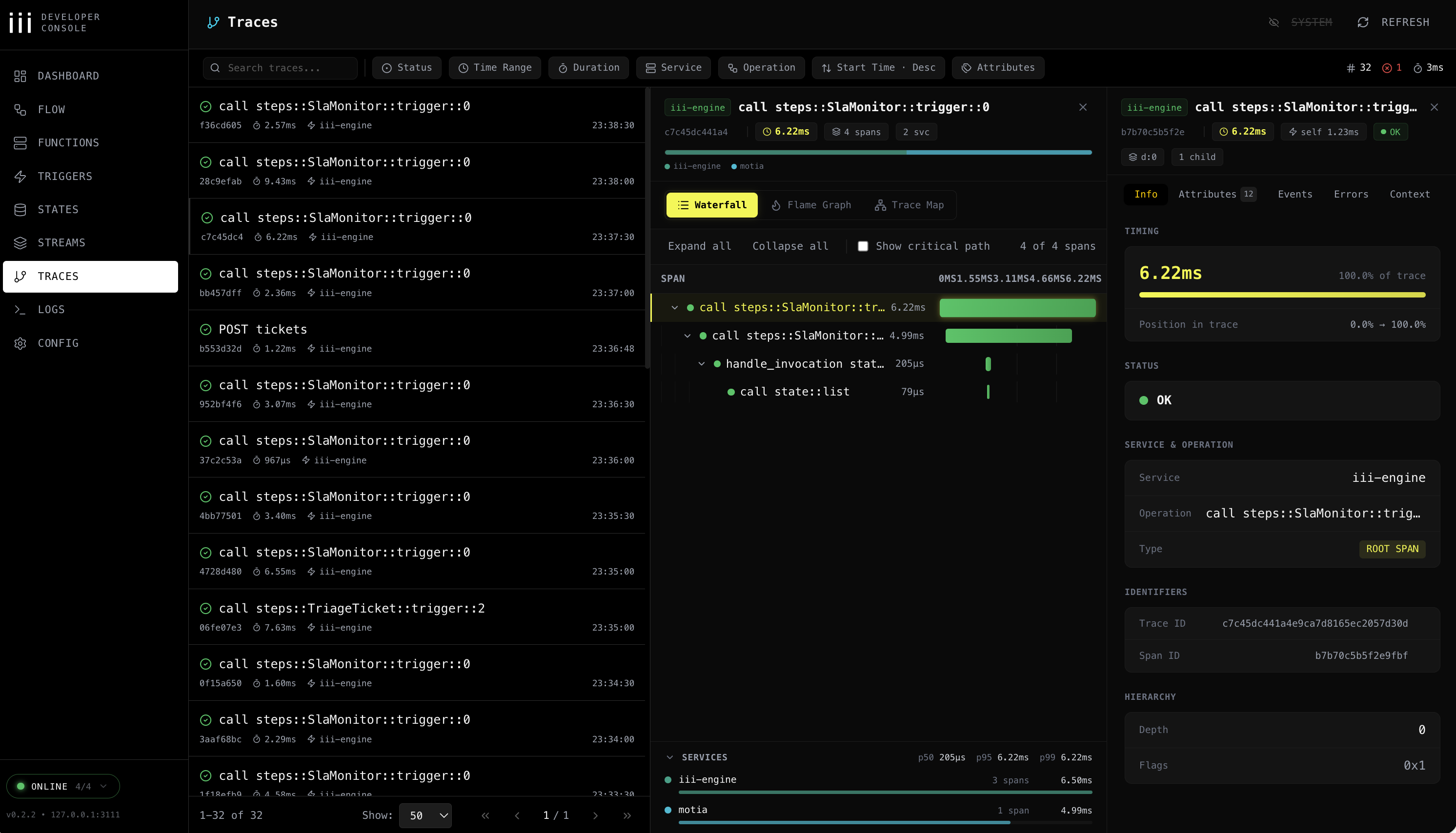
iii console — trace-level engine inspection
agentmemory runs on the iii engine, so the official iii console gives you OpenTelemetry traces, the raw key/value state store, the stream monitor, and a direct function invoker for every piece of memory machinery. Use it to watch a memory.search call hit BM25 → embeddings → reranker in real time, replay a hook invocation, or poke individual functions without going through MCP.
Dashboard: functions, triggers, workers, streams, live flow graph. Screenshot from iii.dev/docs/console.
Install once:
curl -fsSL https://install.iii.dev/console/main/install.sh | sh
Launch alongside agentmemory:
# The agentmemory viewer already holds port 3113, so run the console on 3114.
iii-console --port 3114 --engine-port 3111 --ws-port 3112
Then open http://localhost:3114.
What you can do from the console:
Page
Use it to
Functions
Invoke any of agentmemory's ~33 functions directly with a JSON payload — handy for testing memory.recall, memory.consolidate, graph.query without wiring a client.
Triggers
Replay HTTP triggers (the agentmemory REST endpoints), fire the consolidation cron manually, or emit queue events.
States
Browse the KV store — sessions, memory slots, lifecycle timers, embeddings index — and edit values in place.
Streams
Watch live memory writes, hook events, and observation updates as they flow through iii's WebSocket stream.
Traces
OpenTelemetry waterfall / flame / service-breakdown views. Filter by trace_id to see exactly which functions, DB calls, and embedding requests a single memory.search produced.
Logs
Structured OTEL logs correlated to trace/span IDs.
Traces: waterfall / flame / service breakdown for every memory operation.
Traces are already on:
iii-config.yaml ships with the iii-observability worker enabled (exporter: memory, sampling_ratio: 1.0, metrics + logs). No extra config needed — the moment agentmemory starts, every memory operation emits a trace span and a structured log the console can read.
If you want to export to Jaeger/Honeycomb/Grafana Tempo instead, change exporter: memory to exporter: otlp and set the collector endpoint per iii's observability docs.
Heads-up: no auth is enforced on the console itself — keep it bound to 127.0.0.1 (the default) and never expose it publicly.
LLM Providers
agentmemory auto-detects from your environment. No API key needed if you have a Claude subscription.
Provider
Config
Notes
Claude subscription (default)
No config needed
Uses @anthropic-ai/claude-agent-sdk
Anthropic API
ANTHROPIC_API_KEY
Per-token billing
MiniMax
MINIMAX_API_KEY
Anthropic-compatible
Gemini
GEMINI_API_KEY
Also enables embeddings
OpenRouter
OPENROUTER_API_KEY
Any model
Environment Variables
Create ~/.agentmemory/.env:
# LLM provider (pick one, or leave empty for Claude subscription)# ANTHROPIC_API_KEY=sk-ant-...# GEMINI_API_KEY=...# OPENROUTER_API_KEY=...# Embedding provider (auto-detected, or override)# EMBEDDING_PROVIDER=local# VOYAGE_API_KEY=...# Search tuning# BM25_WEIGHT=0.4# VECTOR_WEIGHT=0.6# TOKEN_BUDGET=2000# Auth# AGENTMEMORY_SECRET=your-secret# Ports (defaults: 3111 API, 3113 viewer)# III_REST_PORT=3111# Features# AGENTMEMORY_AUTO_COMPRESS=false # OFF by default (#138). When on,# every PostToolUse hook calls your# LLM provider to compress the# observation — expect significant# token spend on active sessions.# AGENTMEMORY_SLOTS=false # OFF by default. Editable pinned# memory slots — persona,# user_preferences, tool_guidelines,# project_context, guidance,# pending_items, session_patterns,# self_notes. Size-limited; agent# edits via memory_slot_* tools.# Pinned slots addressable for# SessionStart injection.# AGENTMEMORY_REFLECT=false # OFF by default. Requires SLOTS=on.# Stop hook fires mem::slot-reflect:# scans recent observations, auto-# appends TODOs to pending_items,# counts patterns in# session_patterns, records touched# files in project_context. Fire-# and-forget; does not block.# AGENTMEMORY_INJECT_CONTEXT=false # OFF by default (#143). When on:# - SessionStart may inject ~1-2K# chars of project context into# the first turn of each session# (this is what actually reaches# the model — Claude Code treats# SessionStart stdout as context)# - PreToolUse fires /agentmemory/enrich# on every file-touching tool call# (resource cleanup, not a token# fix — PreToolUse stdout is debug# log only per Claude Code docs)# Observations are still captured via# PostToolUse regardless of this flag.# GRAPH_EXTRACTION_ENABLED=false# CONSOLIDATION_ENABLED=true# LESSON_DECAY_ENABLED=true# OBSIDIAN_AUTO_EXPORT=false# AGENTMEMORY_EXPORT_ROOT=~/.agentmemory# CLAUDE_MEMORY_BRIDGE=false# SNAPSHOT_ENABLED=false# Team# TEAM_ID=# USER_ID=# TEAM_MODE=private# Tool visibility: "core" (8 tools) or "all" (51 tools)# AGENTMEMORY_TOOLS=core
107 endpoints on port 3111. The REST API binds to 127.0.0.1 by default. Protected endpoints require Authorization: Bearer <secret> when AGENTMEMORY_SECRET is set, and mesh sync endpoints require AGENTMEMORY_SECRET on both peers.
One breaking change: the REST API now requires auth by default. Everything bundled (CLI, viewer, hooks, MCP, `connect` configs) reads the generated secret on its own, so only hand-written requests to `:3111` need `Authorization: Bearer $(cat ~/.agentmemory/secret)`. Stores load unchanged; one-time migrations run by themselves on first start. ## Breaking - Auth on by default: secret generated into `~/.agentmemory/secret` when `AGENTMEMORY_SECRET` is unset (#1462) - Writes need `Content-Type: app
High
10/6/2026
v0.9.29
No breaking changes, drop-in upgrade. ## Added - Cursor plugin: 7 auto-capture hooks + 17 skills + MCP, IDE and `cursor-agent` CLI - Devin support: `connect devin --with-hooks` (6 native hooks) and a Devin plugin manifest for `/agentmemory:<skill>` commands - DeepSeek Harness connector (`connect dsh`), with `--with-hooks` for full auto-capture - `connect pi` now actually installs the extension; capture reaches parity with the Claude Code plugin - Two new skills, 15 → 17: `memory-discipline` (wh
High
8/16/2026
v0.9.28
No breaking changes, drop-in upgrade. ## Security - Closed cross-agent memory leak via `/agentmemory/context` under `AGENTMEMORY_AGENT_SCOPE=isolated` (#1057) ## Fixed - Hooks no longer crash ("hook exited with code 1") on a null payload from Codex CLI / Claude Code (#1047) - Engine conflict no longer hangs in a WS reconnect loop; clean recovery and pinned-engine guidance (#984) - Onboarding stat drift and over-strict engine version gate (#852) ## Added - `agentmemory demo --serve`: one-comma
High
7/19/2026
v0.9.27
Wave release closing several breaking regressions reported against v0.9.26, plus an agent-scope isolation security fix, an iii version-pin audit fix, and a benchmark scorecard correction. No breaking changes; drop-in upgrade. ## Security - **`AGENTMEMORY_AGENT_SCOPE=isolated` not enforced on `mem::search` / `POST /agentmemory/search` / `memory_recall` / `recall_context`** ([#817](https://github.com/rohitg00/agentmemory/issues/817)). PR #654's isolation work covered smart-search, `/memories
High
6/7/2026
v0.9.26
Hotfix on top of v0.9.25. Closes [#797](https://github.com/rohitg00/agentmemory/issues/797). ## Fixed - **First boot crash: `TypeError: Cannot read properties of undefined (reading 'v')`** (#797). The sharded index load path checked `manifest.value !== null` before forwarding, but some iii-state adapters return `undefined` (not `null`) for a missing key. `loadManifestData(undefined)` then crashed on `undefined.v`. Now treats both null + undefined + non-object values as 'no manifest' and falls
High
6/3/2026
v0.9.22
Stability + ecosystem wave. Three install-broken bugs (`npm install` ERESOLVE, non-OpenAI base URLs, broken Claude bridge path) closed. Six runtime bugs from active users fixed end-to-end. Three new agent integrations (Qwen Code, Antigravity, Kiro). New `AGENT_ID` scope for multi-agent setups. Port mapping documented. ### Fixed - **`npm install` ERESOLVE on fresh install** ([PR #649](https://github.com/rohitg00/agentmemory/pull/649), closes [#631](https://github.com/rohitg00/agentmemory/issue
High
5/26/2026
v0.9.21
## [0.9.21] — 2026-05-19 Quality + integration wave. Headline: native OpenCode plugin with full Claude Code hook parity ([#237](https://github.com/rohitg00/agentmemory/pull/237) by [@cl0ckt0wer](https://github.com/cl0ckt0wer)). Ten more PRs alongside: `memory_recall` returning the wrong shape, env-file `AGENTMEMORY_DROP_STALE_INDEX` silently ignored, hook scripts crashing on Windows usernames with spaces, viewer search inputs interrupting CJK IME composition, large sessions silently failing at
High
5/19/2026
v0.9.16
Two waves: (1) DevEx polish on top of v0.9.15 — 5-port ready panel, iii console install, interactive global-install prompt, onboarding now actually wires the agents you select, MCP reworded as opt-in. (2) Marketing site refresh — new AS FEATURED IN bar (AlphaSignal · Agentic AI Foundation · Trendshift) + Agents/Compare/CommandCenter/Hero updated for the v0.9.15 surface. ## Added - **5-port ready panel** (#410). Single clack note replaces the old single-line ready hint. Lists REST / Viewer / St
High
5/15/2026
v0.9.5
Bug-fix patch focused on **search recall correctness** and **plugin compatibility**. Pins `iii-engine` to v0.11.2 because v0.11.6 introduces a new sandbox-everything-via-`iii worker add` model that agentmemory hasn't been refactored for yet — pin lifts once that refactor lands. Adds a hard guard against silent vector-index corruption, fixes BM25 indexing for memories saved via `memory_save`, and lands four Hermes plugin fixes that make the memory provider actually usable end-to-end. If you've
High
5/9/2026
v0.9.4
Bug-fix patch. Fixes a silent gap where the knowledge graph never auto-populated despite `GRAPH_EXTRACTION_ENABLED=true`, and adds a doctor check that detects when Claude Code fails to load plugin hooks. ## Fixed - **`mem::graph-extract` now auto-fires at session end.** When `GRAPH_EXTRACTION_ENABLED=true`, the function was registered and the REST endpoint was live, but no internal caller invoked it — the graph KV stayed empty unless users manually `POST`ed to `/agentmemory/graph/extract`. `ev
High
4/29/2026
v0.9.3
## [0.9.3] — 2026-04-24 Developer-experience patch. Every disabled feature flag is now visible in the viewer, the CLI, and REST error responses, so devs no longer hit empty tabs wondering whether the install is broken or just opt-in. Adds a `doctor` command that diagnoses the whole stack in one shot and a first-run hero in the viewer that points at the magical-moment `demo` command. ### Added - **`agentmemory doctor` command.** Runs 10 diagnostic checks in one shot: server reachability, healt
High
4/24/2026
v0.9.2
Safety + import-pipeline patch. Kills the infinite Stop-hook recursion loop that burned Claude Pro tokens on unkeyed installs, repairs every empty viewer tab after `import-jsonl`, derives lessons and crystals automatically from imported sessions, and opens up OpenAI-compatible embedding endpoints. ## Contributors - **@Edison-A-N** — #186: `OPENAI_BASE_URL` + `OPENAI_EMBEDDING_MODEL` env vars (unlocks Azure / vLLM / LM Studio for embeddings). - **@Tanmay-008** and **@tanmaishi** — #111 / #179 f
High
4/22/2026
v0.9.1
Trust-the-CLI patch. Three bugs that surfaced in real testing of v0.9.0: the dashboard viewer showed zeros for half its cards, `import-jsonl` crashed on anything but a perfect response, and `upgrade` hard-aborted on a cargo registry that never had the crate. ### Fixed - **Viewer dashboard list endpoints** (#172). `GET /agentmemory/semantic` and `GET /agentmemory/procedural` were never registered, and `GET /agentmemory/relations` returned 405 because only the POST trigger existed. The dashboard
High
4/20/2026
v0.9.0
Visibility + correctness release. Landing site, filesystem connector, MCP standalone now actually talks to the running server, health logic stops crying wolf, audit trail closes its last gap, and every memory path has a clear policy. ## Highlights - **Website** — Next.js 16 App Router landing page at [`website/`](https://github.com/rohitg00/agentmemory/tree/v0.9.0/website). Lamborghini-inspired dark canvas, live GitHub stars pill, agents marquee with real brand logos, command-center tab showcas
High
4/18/2026
v0.8.12
Release 0.8.12
High
4/16/2026
v0.8.11
## What's Fixed `node dist/index.mjs` crashed on startup after the iii-sdk v0.11 migration (#116) merged: ``` SyntaxError: The requested module 'iii-sdk' does not provide an export named 'getContext' ``` iii-sdk v0.11 dropped `getContext()` entirely. 32 `src/functions/*.ts` files still imported and called it. The bug was invisible to CI (tests mock iii-sdk) and build (tsdown doesn't type-check). ### Changes - **`src/logger.ts`** — new thin stderr shim with `.info/.warn/.error` replacing `ge
High
4/15/2026
v0.8.10
**Behavior change**: the PreToolUse and SessionStart hooks no longer run enrichment by default. SessionStart saves ~1-2K input tokens per session you start (the only path that was actually reaching the model, per the [Claude Code hook docs](https://code.claude.com/docs/en/hooks.md)). PreToolUse stops spawning a Node process and POSTing to \`/agentmemory/enrich\` on every file-touching tool call — a pure resource cleanup, not a token fix. If you were relying on either path, set \`AGENTMEMORY_INJE
High
4/15/2026
v0.8.9
Two UX fixes for the Claude Code plugin install path, reported in [#139](https://github.com/rohitg00/agentmemory/issues/139) by [@stefanfaur](https://github.com/stefanfaur). ## Fixed - **Claude Code plugin now auto-wires the MCP server** ([#139](https://github.com/rohitg00/agentmemory/issues/139)) — new `plugin/.mcp.json` declares the `@agentmemory/mcp` stdio server so `/plugin install agentmemory@agentmemory` auto-starts it when the plugin is enabled. No extra config step, no separate install
High
4/14/2026
v0.8.8
**Behavior change**: per-observation LLM compression is now opt-in. If you were relying on LLM-generated summaries, set \`AGENTMEMORY_AUTO_COMPRESS=true\` in \`~/.agentmemory/.env\` and restart. ## Fixed - **Stop silently burning Claude API tokens on every tool invocation** ([#138](https://github.com/rohitg00/agentmemory/issues/138), thanks [@olcor1](https://github.com/olcor1)) — the old \`mem::observe\` path fired \`mem::compress\` unconditionally on every PostToolUse hook, which called Claud
Medium
4/14/2026
v0.8.7
Brown-paper-bag fix for [#136](https://github.com/rohitg00/agentmemory/issues/136), reported by [@stefano-medapps](https://github.com/stefano-medapps). If you hit \`Failed to read config file '/app/config.yaml': Is a directory\` on a fresh \`npx @agentmemory/agentmemory\`, this release fixes it. ## What broke The 0.8.6 tarball shipped \`docker-compose.yml\` but not \`iii-config.docker.yaml\`, even though the compose file mounts \`./iii-config.docker.yaml:/app/config.yaml:ro\`. Docker resol
Medium
4/14/2026
v0.8.6
Finishes the #120 story: a dedicated standalone package for `npx`, minus the name-collision problem. ## Changed - **Standalone MCP shim is now `@agentmemory/mcp`** — 0.8.5 tried to publish it as unscoped `agentmemory-mcp`, but npm's name-similarity policy rejects that name because of an unrelated third-party package called `agent-memory-mcp`. The shim now lives under the scope we already own, so `npx -y @agentmemory/mcp` works on the live registry. All README snippets, the OpenClaw and Hermes
High
4/13/2026
v0.8.5
Compatibility fix for stricter JSON-RPC clients, plus a spec cleanup CodeRabbit caught during review. ## Fixed - **MCP server works with Codex CLI and any strict JSON-RPC 2.0 client** ([#129](https://github.com/rohitg00/agentmemory/issues/129)) — the stdio transport was responding to JSON-RPC **notifications** (messages without an `id` field, e.g. `notifications/initialized`), which violates JSON-RPC 2.0 §4.1 and caused stricter clients like Codex CLI v0.120.0 to close the transport with "Tran
Medium
4/13/2026
v0.8.2
## Security Release This release ships **6 security fixes** addressing vulnerabilities in default deployments. **Users on v0.8.1 should upgrade immediately.** ### Fixed CVEs | Severity | Issue | |---|---| | 🔴 CRITICAL | Stored XSS in real-time viewer (inline `onclick=` + `script-src 'unsafe-inline'`) | | 🔴 CRITICAL | `curl \| sh` remote shell execution in CLI startup | | 🟠 HIGH | Default `0.0.0.0` binding exposed memory store on LAN | | 🟠 HIGH | Unauthenticated mesh sync endpoints | | 🟡
Medium
4/12/2026
v0.8.1
## Bug Fixes - **Viewer not found via npx (#109)**: Build now copies `index.html` to `dist/viewer/`. Path resolution covers npx, tsx dev, and repo root deployments. ## New - **Hermes Agent memory provider plugin**: Full `MemoryProvider` ABC implementation at `integrations/hermes/`. SSRF-safe URL validation, non-blocking `sync_turn`, context injection on `on_pre_compress`. - **12 agents in README**: Added OpenClaw (345K stars), Codex CLI (62K), Cline (59K), Aider (42K), Goose (33K), Kilo Code
High
4/9/2026
v0.8.0
## New Features ### Viewer dark mode Toggle in the header — persists to localStorage, respects `prefers-color-scheme`. All canvas graph colors (grid, labels, tooltips, node pills) adapt correctly. Thanks to the editorial design system already using CSS custom properties, the entire viewer switches cleanly. ### MiniMax LLM provider (#103) New provider for MiniMax's Anthropic-compatible API. Uses raw `fetch` to bypass SDK `x-stainless-*` headers that MiniMax rejects with 403. Configure with `MIN
Medium
4/9/2026
v0.7.9
## Bug Fix - **skills path**: Changed from `../skills/` to `./skills/` in plugin.json. Claude Code resolves paths relative to the plugin root, not relative to plugin.json. (Thanks @chendonghui1) Closes #94 **Full Changelog**: https://github.com/rohitg00/agentmemory/compare/v0.7.8...v0.7.9
High
4/8/2026
v0.7.8
## Bug Fixes - **hooks.json format** (#100): Each event entry now uses the correct nested `{ hooks: [{ type, command }] }` format. Claude Code expects hooks wrapped in an array, not flat `{ type, command }` at the top level. - **skills validation** (#94): Changed from explicit file path array to directory reference `["../skills/"]` matching the convention used by working plugins. Plugin install should now work cleanly: ``` /plugin marketplace add rohitg00/agentmemory /plugin install agentmemor
Medium
4/8/2026
v0.7.7
## Bug Fix Fixes `/plugin install agentmemory` failing with validation errors (#94). **Root cause**: `plugin.json` had three schema violations: - `author` was a string — must be an object `{name, url}` - `hooks` was a file path — must be omitted (auto-loaded by convention from `hooks/hooks.json`) - `skills` was a directory string — must be an array of explicit paths Users can now install cleanly: ``` /plugin marketplace add rohitg00/agentmemory /plugin install agentmemory ``` Closes #94 **F
Medium
4/7/2026
v0.7.6
## New Features ### Cross-encoder reranking (#90) Opt-in rerank step after hybrid search via `RERANK_ENABLED=true`. Uses `@xenova/transformers` MiniLM-L-6-v2 cross-encoder on top-20 candidates. Graceful fallback when model unavailable. ### Working memory / context window (#58) Core memory system with pinned facts (always included in context) + automatic paging of archival memories. 5 new functions: `mem::core-add`, `mem::core-remove`, `mem::core-list`, `mem::working-context`, `mem::auto-page`.
Medium
4/7/2026
v0.7.5
## Fixes This release fixes all installation bugs reported by users trying to set up agentmemory for the first time. ### npm install fails (ERESOLVE) `@anthropic-ai/claude-agent-sdk@0.2.56` requires `zod@^4.0.0` as a peer dependency, but agentmemory had `zod@^3.23.0`. Updated to `zod@^4.0.0`. ### Docker: "Config file not found: /app/config.yaml" `docker-compose.yml` was missing the config mount. Added `./iii-config.yaml:/app/config.yaml:ro` volume. ### Docker: engine unreachable after contai
Medium
4/7/2026
v0.7.4
## What's New ### Reflect — higher-order insight synthesis (#89) The headline feature competitors like Hindsight charge for. `memory_reflect` traverses the knowledge graph, groups related memories by concept clusters, and synthesizes higher-order insights via LLM. ```bash # Trigger via MCP memory_reflect # Or REST POST /agentmemory/reflect ``` **How it works:** 1. Finds high-degree concept nodes in the knowledge graph 2. BFS clusters related concepts (depth=2) 3. Gathers semantic memories,
Medium
4/6/2026
v0.7.3
## Fixes - **#84** Fixed `CrystallizableAction` type error that broke `tsc --noEmit` - **#85** Added `files` field to package.json — npm package reduced from 40MB to 11.6MB - **#92** Updated README function table — all 89 mem:: functions documented in categorized table - Fixed `mem::temporal-graph` (nonexistent) → `temporal-graph-extract` + `temporal-query` - Updated stale test/stats counts across README and AGENTS.md ## Tests - **#86** 22 tests for lessons (save, recall, list, strengthen, deca
Medium
4/6/2026
v0.7.2
## What's New ### Zero-config startup ```bash npx @agentmemory/agentmemory ``` Auto-installs iii-engine if missing (interactive prompt), starts the engine, runs the worker. ### Viewer updates - Lessons tab with search, confidence gauges, reinforcement counts, source badges - Lessons + Crystals stat cards on dashboard ### Install methods for iii-engine - `curl -fsSL https://install.iii.dev/iii/main/install.sh | sh` - `cargo install iii-engine` - Docker: `docker pull iiidev/iii:latest` Install
Medium
4/5/2026
v0.7.1
Scoped package name to `@agentmemory/agentmemory` for npm publishing. Install: `npm install @agentmemory/agentmemory` No code changes from v0.7.0 — package.json name + repository fields updated.
Medium
4/5/2026
v0.7.0
## What's New Five DX improvements based on competitive research against Mem0, Engram, CodeMem, and 30+ agent memory tools: ### `npx agentmemory` zero-config startup CLI bootstrap auto-detects and starts iii-engine (tries `iii` binary, falls back to Docker). No manual engine setup required. ### Simplified MCP surface (7 core tools) `AGENTMEMORY_TOOLS=all` unlocks all 41 tools. Default shows only: save, recall, consolidate, smart_search, sessions, diagnose, lesson_save. ### First-class lesson
Medium
4/4/2026
Dependencies & License Audit
Loading dependencies...
Similar Packages
typescript-sdkThe official TypeScript SDK for Model Context Protocol servers and clientsv2.4.0

 The gist extends Karpathy's LLM Wiki pattern with confidence scoring, lifecycle, knowledge graphs, and hybrid search.







 Works with any agent that speaks MCP or HTTP. One server, memories shared across all of them.