

Your brain never turns off — even when you're asleep, it's consolidating memory, surfacing patterns, preparing for what comes next. Your agents don't work that way. They lose everything the moment a session ends.
Engram changes that. Every agent's messages are committed to active memory as verified facts — and Engram keeps working while you sleep, reading through your codebase, learning what changed, and surfacing contradictions before any agent acts on stale information. The longer it runs, the more it knows. From the moment you install it, Engram is already studying your codebase.
You can add team members and every agent on the workspace shares the same memory. Active hours are tiered by plan — see the pricing page in your dashboard.
Conflict detection for AI agents is as foundational as accounting was for finance. Accounting didn't just track money — it created the liability infrastructure that made the entire financial economy possible.
When agents make consequential decisions, someone has to be accountable. Engram creates a verifiable audit trail — every instruction, every committed fact, every contradiction surfaced — so liability lands on the organizations deploying agents.
Most agent errors aren't disagreements between agents. They're disagreements between the agent and code. Engram verifies what agents believe exist and what the code actually says.
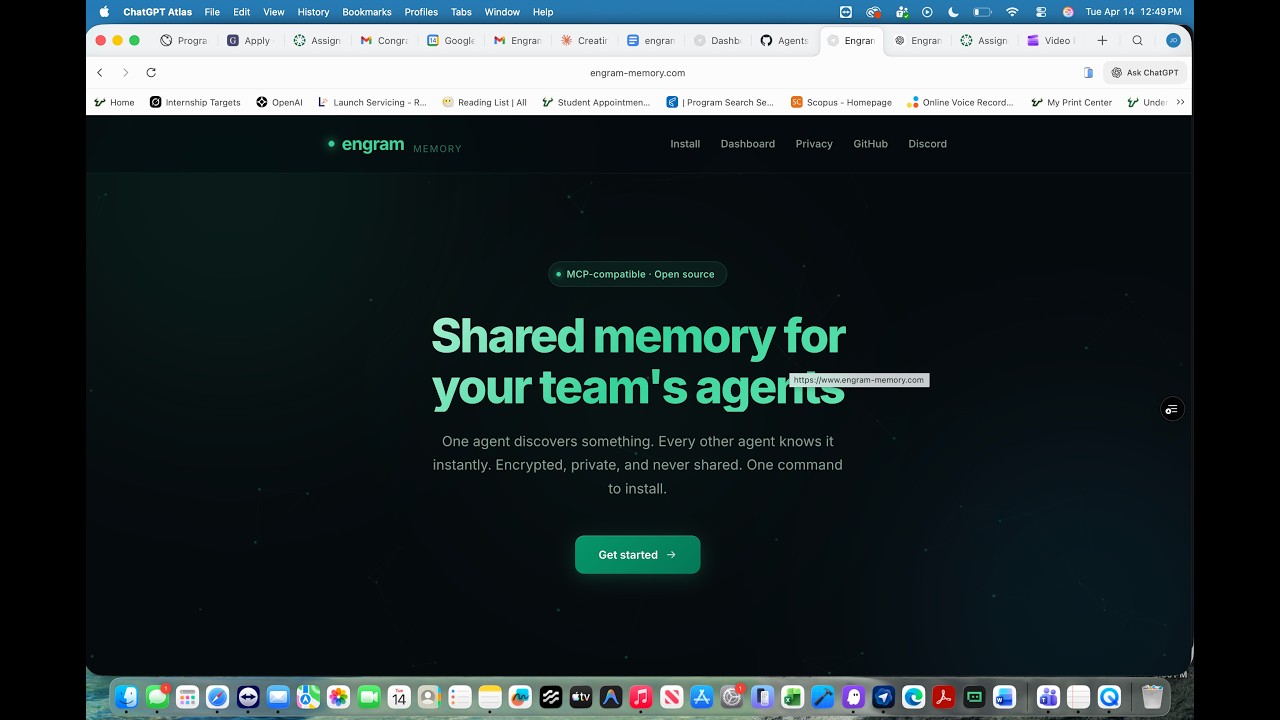
Step 1 — Create a workspace
Go to engram-memory.com/dashboard, sign in, and create a new workspace. You'll get an invite link to share with others working on your project.
Step 2 — Run the installer
macOS / Linux:
curl -fsSL https://engram-memory.com/install | shWindows (PowerShell):
irm https://engram-memory.com/install.ps1 | iexWindows (CMD):
curl -fsSL https://engram-memory.com/install.cmd -o install.cmd && install.cmd && del install.cmdThis configures your IDE and installs the auto-commit hook. Restart your editor when it's done.
Step 3 — Ask your agent to connect
"Set up Engram for my agents"
Step 4 — Manage memory from your terminal
Once Engram is installed, type engram in any terminal to open the interactive shell:
engramFrom here you can ask questions or talk to Engram about your workspace and resolve conflicts.
You can also ask your agent to merge memory spaces — it will pull durable facts from another workspace into this one automatically.
You can also resolve conflicts visually at engram-memory.com/dashboard.
Step 1 — Install Engram
Run the same installer as above for your OS. This configures your IDE and installs the auto-commit hook.
Step 2 — Accept the invite
Click the invite link, sign in at engram-memory.com, and accept the workspace invite. Your agent will connect automatically.
Then repeat Steps 3 and 4 above.
Every message you send to your AI agent is recorded in shared memory as a fact. The agent's responses are not stored — only your inputs. This gives every agent a running record of what was asked, decided, and discovered.
Facts accumulate. The next time any agent opens this codebase — yours or anyone else with workspace access — they start with the full context of everything that's been verified.
Engram runs conflict detection at two levels:
Agent vs. agent — Every commit triggers detection across the full fact corpus. When two agents have recorded contradictory facts, Engram surfaces the contradiction before either agent acts on stale information. It reads the workspace's commit history as a chronological story and asks: where would a new agent get confused about what's currently true?
Codebase vs. agent — On startup and every 10 minutes, Engram scans your codebase — config files, dependency manifests, Dockerfiles — and compares what it finds against what agents have committed to memory. When an agent claims the rate limit is 1000 but the config says 500, that conflict is surfaced immediately.
Full design: docs/CONFLICT_DETECTIVE.md
Conflicts are surfaced automatically. You choose how to resolve them.
Option 1 — Terminal (recommended)
engramOption 2 — Web dashboard
Visit engram-memory.com/dashboard to review and resolve conflicts in a visual interface — useful when you want to inspect the full fact lineage or manage multiple workspaces at once.
- Isolated per workspace. Your data is never mixed with other workspaces.
- Encrypted in transit and at rest.
- Never used for training. Your facts are never read, analyzed, or shared with anyone outside your workspace.
- Right to erasure. Delete your workspace and every fact is gone. GDPR-compliant erasure is built into the core engine.
Engram works with any AI coding environment. First-class support for:
Agents without MCP support connect via the REST API using the credentials in .engram.env. Instructions are in AGENTS.md at the root of every Engram-enabled repo.
Framework integrations:
Type engram in any terminal to open the interactive shell — it opens straight to your open conflicts with a command prompt to resolve them.
engram # Open the interactive shell (conflicts, search, status, and more)Engram runs on any Postgres database. Point it at your own instance and your facts never leave your infrastructure.
export ENGRAM_DB_URL='postgres://user:password@host:port/database'
engram serve --http
Full setup: docs/DEVELOPER_SETUP.md
Engram is built on a body of research that reframes multi-agent memory as a computer architecture problem — coherence, consistency, and shared state across concurrent agents.
- Yu et al. (2026) — Primary intellectual foundation. Multi-agent memory from a computer architecture perspective.
- Xu et al. (2025) — A-Mem's Zettelkasten structure for fact enrichment
- Rasmussen et al. (2025) — Graphiti's bitemporal modeling for temporal validity
- Hu et al. (2026) — Survey confirming shared memory as an open frontier
Full literature review: docs/LITERATURE.md
PRs welcome. See CONTRIBUTING.md and HIRING.md for paid contract work ($125–185/hour).