




Local cognitive runtime with a shared brain across Claude Code, Codex, Claude Desktop, and other MCP clients. Persistent memory, durable workflow runs, selectable terminal and automation backends, overnight learning, self-healing background jobs, startup preflight, and doctor diagnostics. 150+ MCP tools. Benchmarked on LoCoMo (F1 0.588, +55% vs GPT-4).
NEXO Brain transforms any MCP-compatible AI agent from a stateless assistant into a cognitive partner that remembers, learns, forgets, adapts, and builds a relationship with you over time.
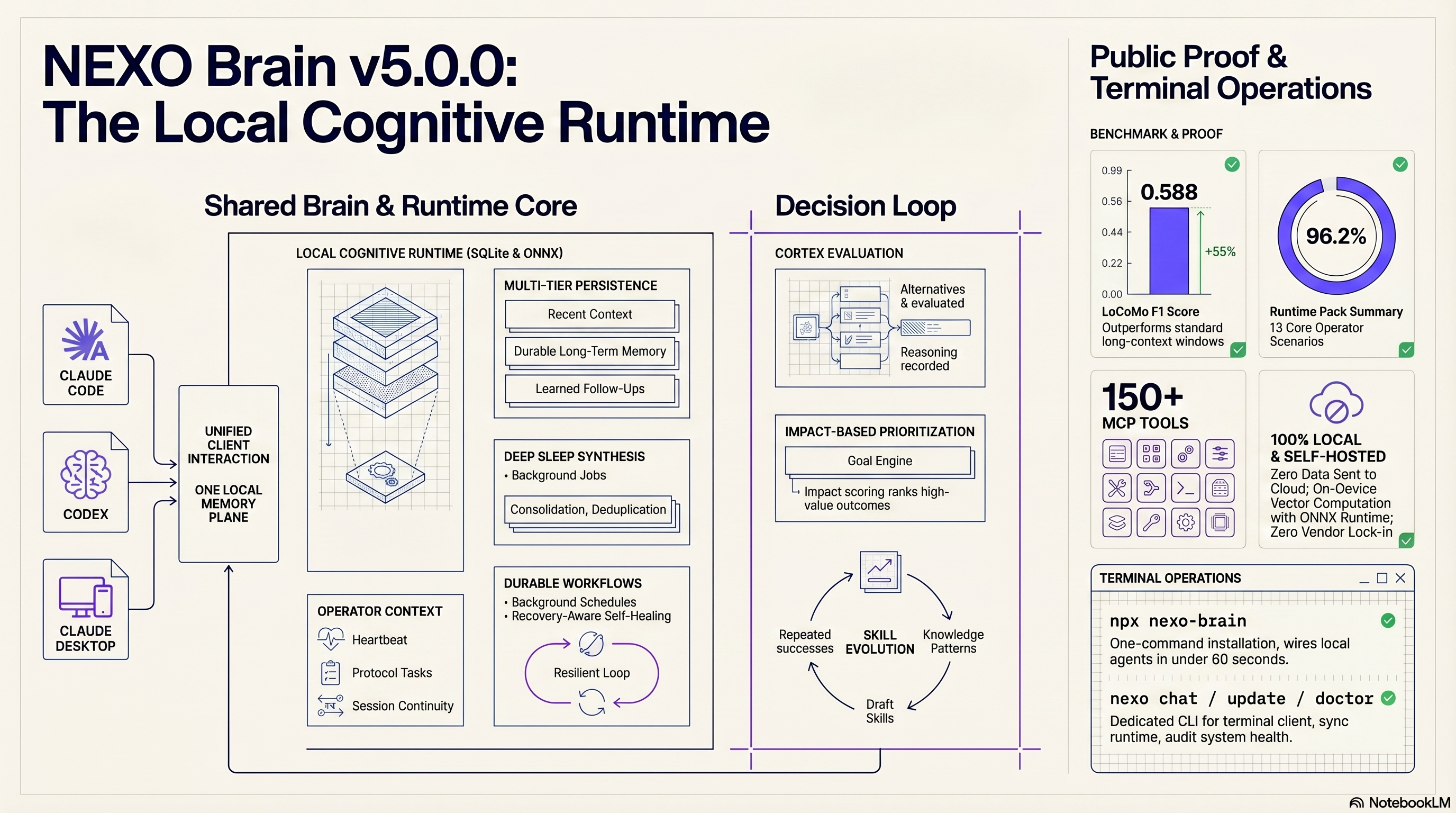
Watch the overview video · Watch on YouTube · Open the infographic
Version 7.1.6 is the current packaged-runtime line. It closes the remaining schedule-governance gap between Brain and Desktop: structural core crons now expose dedicated cadence overrides via schedule-overrides.json, explicit-home product checks stay isolated from the operator machine's global Desktop install markers, and the shipped synthesis launchagent template/docs are realigned with the live 06:00 daily schedule again. The companion NEXO Desktop client (v0.22.6, closed-source distributed separately) adds a dedicated Core schedules surface over the same coordinated contract.
Previously in 7.0.1: hotfix over v7.0.0 (db._core.DB_PATH was only caller still hardcoded to legacy ~/.nexo/data/nexo.db; every shared-DB command silently returned empty results post-migration). Previously in 7.0.0: BREAKING — Plan Consolidado fase F0.6: physical separation of the runtime tree into ~/.nexo/{core,personal,runtime}/. The flat layout (~/.nexo/scripts/, brain/, data/, operations/, ...) is gone. Operators on v6.x are auto-migrated on first nexo update; fresh installs land directly in the new tree. New paths.py helpers are transition-aware.
Previously in 6.5.0: Plan Consolidado fase F0.2: operators can now nexo scripts enable|disable|status <name> any personal automation. The cron wrapper honours the flag at every tick (exit 0 with summary='[disabled]' while the LaunchAgent stays loaded). The companion NEXO Desktop client (a closed-source product, distributed separately) wires the same toggle into its Automatizaciones panel. See CHANGELOG for the full diff.
About NEXO Desktop. NEXO Desktop is a separate closed-source companion app distributed at nexo-desktop.com — its source does not live in this repo. When release notes mention Desktop they describe a coordinated client release that consumes the Brain's CLI / MCP contract; the Brain itself is fully usable on its own (terminal, Codex, Claude Code, or any MCP client). If you want the product edition rather than the open-source Brain alone, contact
info@wazion.comand ask about NEXO Desktop.
Previously in 6.4.0: Plan Consolidado fase F1 — multi-tenant email accounts (email_accounts table, nexo email setup interactive wizard, nexo email add --password-stdin --json for machine consumers, idempotent migrator from legacy ~/.nexo/nexo-email/config.json). On post-F0.6 installs that legacy-looking path is only a compatibility alias/shim into ~/.nexo/runtime/nexo-email/config.json; it should never be treated as a second source of truth.
Previously in 6.3.1: privacy hotfix over v6.3.0. The nightly auditor caught that src/presets/entities_universal.json in v6.3.0 shipped operator-specific vhost_mapping entries (private IPs, hostnames, tenant names). v6.3.1 pulls those out into src/presets/entities_local.sample.json (template) + .gitignore'd ~/.nexo/brain/presets/entities_local.json (operator copy), and the installer drops the sample at nexo init. No behaviour change on the Guardian side.
Previously in 6.3.0 — Plan Consolidado wave 2, coordinated with NEXO Desktop v0.18.0. Closes the remaining Guardian roadmap items that do not require an invasive structure migration: extended cognitive_sentiment shape (is_correction/valence/intent), extended entities schema, 21 labelled rule fixtures with R13 spike gates, Fase F telemetry loops + Deep Sleep phase, pinned local zero-shot classifier skeleton (mDeBERTa), hook respects NEXO_MIGRATING=1, origin column on personal_scripts, and the T4 LLM gate wrapping R15/R23e/R23f/R23h (byte-parity Py ↔ JS). Two pre-release auditors flagged a CRITICAL in the first JS wire (method-name + async mismatch) and a HIGH (classifier bool conflated "no" with "unparseable"); both corrected with regression tests before merge.
Previously in 6.1.1: small fix to nexo --help so the Latest: vX line reliably appears when NEXO Desktop invokes the CLI via subprocess — unblocks the Desktop Brain auto-update banner that previously couldn't parse the version delta. No behaviour change for interactive terminal users; the 6-hour registry cache still rate-limits network calls. Bundles all v6.1.0 Protocol Enforcer Fase 2 + multi-claude-sid hotfix content.
Previously in 6.0.2: adds the reserved caller prefix personal/* so scripts living in ~/.nexo/scripts/ can invoke the automation backend with their own caller id without editing src/resonance_map.py. New kwarg tier ("maximo" / "alto" / "medio" / "bajo") on run_automation_prompt, run_automation_interactive, nexo_helper.run_automation_text, nexo_helper.run_automation_json, and nexo-agent-run.py --tier. Precedence for personal/* callers: explicit tier= → explicit reasoning_effort= → calibration.preferences.default_resonance → DEFAULT_RESONANCE (alto). Registered callers keep their behaviour unchanged. New guide: docs/personal-scripts-guide.md.
Previously in 6.0.1: hotfix on top of the 6.0.0 release. protocol_settings.py now treats the process as interactive when either stdin+stdout are TTYs or NEXO_INTERACTIVE=1 is exported — closes the gap where NEXO Desktop 0.12.0 spawned claude through pipes and Brain fell back to lenient even with a human in the loop. The PostToolUse hook also gains an inbox autodetect stage: when the session has unread nexo_send messages and has gone 60s+ without a heartbeat, it emits a systemMessage asking the agent to run nexo_heartbeat and consume them. Rate-limited to one reminder per minute per SID (new hook_inbox_reminders table, migration m42). Added sessions.last_heartbeat_ts, stamped by every successful heartbeat. NEXO_INTERACTIVE is an internal Brain↔Electron contract — not user-facing, not a resurrection of the removed NEXO_PROTOCOL_STRICTNESS.
Previously in 6.0.0: BREAKING tier-only setup. Onboarding asks for one resonance tier (maximo/alto/medio/bajo) and that choice drives every backend via src/resonance_tiers.json; the per-backend model/effort prompts are gone and the legacy client_runtime_profiles.{claude_code,codex}.{model,reasoning_effort} are silently purged from schedule.json on upgrade. Protocol strictness is no longer configurable — interactive TTY sessions run strict, non-TTY (crons, pipes, tests) run lenient; NEXO_PROTOCOL_STRICTNESS env, preferences.protocol_strictness, and the default/normal/off/warn/soft aliases are all removed. preferences.show_pending_at_start moves to NEXO Desktop's electron-store. The seven core hooks are now unified behind src/hooks/manifest.json (plugin and npm modes read the same file), two new hooks ship (Notification for live-session activity and SubagentStop for auto-closing stale protocol_tasks), and auto_capture.py is wired to both UserPromptSubmit and PostToolUse with a persistent 1h dedup table plus an automatic nexo_learning_add on correction matches. ~/.nexo/hooks_status.json is published after every registerAllCoreHooks() so NEXO Desktop ≥0.12.0 can render Hooks activos X/Y. New nexo-brain --skip flag aliases --yes/--defaults. Full suite 1057 passed, 1 skipped.
Previously in 5.10.2: auto-bootstraps brain/profile.json from brain/calibration.json on nexo update when the profile file is missing, empty, or corrupt AND calibration carries at least one of meta.role, meta.technical_level, name, language. NEXO Desktop's Preferencias → Avanzado tab used to render an empty {} for that block when the onboarding flow had been interrupted; now it either shows the seeded profile or a friendly explanation of what each file is for, paired with Desktop v0.11.2 which adds header descriptions to both JSON blocks. Never overwrites a populated profile, never raises, idempotent. Also fixes a latent host-filesystem leak in test_user_facing_caller_with_no_user_default_uses_alto exposed by the v5.10.1 migration.
Previously in 5.10.1: silent, one-shot migration that recovers legacy reasoning_effort="max" (written by nexo preferences --reasoning-effort max before v5.9.0) into the new preferences.default_resonance map — any user who had configured max before v5.9.0 and never touched the new selector was silently falling back to DEFAULT_RESONANCE="alto" on interactive calls since the v5.10.0 update. _run_runtime_post_sync() runs _migrate_effort_to_resonance() exactly once: max→maximo, xhigh→alto, high→medio, medium→bajo. No-op when calibration or schedule already declares an explicit default_resonance; idempotent; conservative; never raises.
Previously in 5.10.0: fixes the deep-sleep extract bloat that made Session 1 take ~57 minutes on some installs (new bare_mode on run_automation_prompt wires claude --bare for JSON-only extractor callers — ~4.3× faster per child, sourced from ANTHROPIC_API_KEY env or ~/.claude/anthropic-api-key.txt). caller= is now mandatory on run_automation_prompt — no silent fallback; every automation subprocess traces back to a registered caller with a deliberate tier. Five personal scripts (personal/email-monitor, personal/github-monitor, personal/post-x, personal/followup-runner, personal/orchestrator-v2) joined the resonance map with tiers picked per caller based on what each one does. gbp/* marketing posts bumped from medio to alto (public-facing copy, quality first over speed). 65 legacy protocol debts bulk-resolved as part of the audit — the patterns that generated them are structurally closed by mandatory caller= + unified session log + bare_mode.
Previously in 5.9.1: adds default_resonance to brain/calibration.json via the Desktop-facing schema (nexo schema --json), so NEXO Desktop's Preferences dialog renders a select with Máximo / Alto (recomendado) / Medio / Bajo automatically — no Desktop release needed. resolve_tier_for_caller reads calibration first and falls back to the legacy schedule.json location. nexo preferences --resonance writes both. The UI control only affects interactive sessions (nexo chat, Desktop new conversation, interactive nexo update); crons and background processes stay pinned per caller in resonance_map.py.
Previously in 5.9.0: every Claude/Codex invocation now flows through a central resonance map and a unified session log. Four tiers (MAXIMO / ALTO / MEDIO / BAJO) each resolve to a concrete (model, reasoning_effort) pair per backend. User-facing callers (nexo chat, Desktop new conversation, interactive nexo update) honour the user's default_resonance preference; system-owned callers (deep-sleep, evolution, catchup, GBP posts, …) run at a fixed tier chosen per caller in src/resonance_map.py — the user's preference never downgrades a cron we decided needs MAXIMO. Unknown callers raise UnregisteredCallerError. Migration #41 adds caller, session_type, started_at, ended_at, pid, resonance_tier to automation_runs; interactive sessions record a row at spawn (with ended_at=NULL) and update it on close, so the Brain now has a single source of truth for every Claude/Codex call regardless of origin. New nexo preferences --resonance CLI. New MCP tools nexo_session_log_create / nexo_session_log_close let NEXO Desktop (which spawns claude directly from its TypeScript process) feed the same log.
Previously in 5.8.2: the Brain core no longer auto-classifies followups and reminders on behalf of agents. v5.8.0's classify_task() heuristic (NEXO-specific ID prefixes NF-PROTOCOL-* / NF-DS-* / NF-AUDIT-*, Spanish user-verbs debes / revisar / firmar, agent keywords monitor / auditoría diaria / checkpoint) was fine for NEXO's own DB but bled convention into every third-party agent plugged into the shared Brain. The core now persists internal=0 and owner=NULL when the caller omits them, and clients that want automatic classification (NEXO Desktop does, via its _legacyClassifyOwner helpers) compute it themselves and pass the result. Migration #40 keeps the columns + indexes; rows already backfilled by v5.8.0 keep their values. normalise_owner still explicitly rejects the string "nexo" so legacy hardcoding cannot sneak back in.
Previously in 5.8.1: closes a self-reinforcing launchctl kickstart -k loop in the watchdog that wedged deep-sleep Phase 2 between 2026-04-14 and 2026-04-17. The cron wrapper now INSERTs an in-flight row (ended_at=NULL) at start and traps SIGTERM/INT/HUP to close it with exit_code=143 instead of vanishing from cron_runs. The watchdog interprets in-flight rows as "currently running" and only re-executes after verifying the worker process is dead. extract.py classifies CLI failures into transient (overloaded_error, rate-limit, timeout, signal — retried next run) and deterministic (skipped after MAX_POISON_ATTEMPTS), and passes a slim shared-context (200 head lines + metadata) instead of the full 400+ KB dump. A new auto_update._heal_deep_sleep_runtime() repairs existing installs silently on the next nexo update: poisoned checkpoints, stale locks, dangling cron_runs rows, and bloated .watchdog-fails counters.
Previously in 5.8.0: first-class internal and owner columns on followups and reminders. Migration #40 adds both fields with an idempotent one-shot backfill, so the "who does this task belong to?" classification moves from client-side regex (Desktop) to persistent storage every MCP client shares. Taxonomy is intentionally generic — owner in {user, waiting, agent, shared} — so third-party agents plugging into the shared Brain can render whatever assistant label they carry without inheriting NEXO branding. nexo_reminder_create, nexo_reminder_update, nexo_followup_create, and nexo_followup_update gain optional internal and owner parameters that win over the default heuristic.
Previously in 5.7.0: nexo update now keeps Claude Code and Codex CLIs in lockstep with NEXO Brain itself. When the global @anthropic-ai/claude-code or @openai/codex packages are installed, the updater checks the npm registry and runs npm install -g <pkg>@latest in-line — so the terminal boot model stays aligned with the settings NEXO already wrote to ~/.claude/settings.json. Packages the operator never installed are skipped silently. Pass nexo update --no-clis to keep the terminal CLIs pinned.
Previously in 5.6.1: update-path hardening — 0-byte .db orphans from interrupted installs are now purged from ~/.nexo/ and ~/.nexo/data/ before the pre-update backup, and sync_claude_code_model() propagates the NEXO-recommended model into ~/.claude/settings.json whenever heal_runtime_profiles() migrates the claude_code default.
Previously in 5.5.5: data-loss guardrails + automatic self-heal. The updater now refuses to capture an already-wiped nexo.db into a pre-update-* snapshot (validated sqlite3.backup + pre-flight wipe guard + post-migration row-count gate), and an auto-heal restores data/nexo.db from the newest hourly backup on the next server boot when a wipe is detected. New nexo recover CLI + nexo_recover MCP tool.
Previously in 5.5.4: Deep Sleep no longer blocks on unparseable sessions — reduced retries, added a JSON escape hatch, and unified the automation subprocess timeout to 3h across all scripts via a single shared constant.
Previously in 5.5.3: CLAUDE.md CORE teaches the model to trust the Protocol Enforcer, so aligned backends stop rejecting heartbeat, diary, and checkpoint injections as suspected prompt injection.
Start here:
- 5-minute quickstart
- Workflow quickstart
- Runtime templates
- Recent memory fallbacks + live system catalog
- Supported client guides
- Docker setup
- Architecture visuals
- Memory classes
- Session portability
- Python SDK
- Reference verticals
- Measured compare scorecard
- Memory benchmark harness
- Public contribution guide
Every time you close a session, everything is lost. Your agent doesn't remember yesterday's decisions, repeats the same mistakes, and starts from zero. NEXO Brain fixes this with a cognitive architecture modeled after how human memory actually works.
Shared brain is now the baseline:
- Claude Code remains the recommended path because it still has the deepest hook integration and the most battle-tested headless automation surface.
- Codex is supported both as an interactive terminal client and as the background automation backend.
- Claude Desktop can point at the same local brain through MCP.
That means NEXO now manages not only the shared runtime and MCP wiring, but also the startup layer around it:
nexo chatopens the configured client instead of assuming Claude Code forever.- Claude Code and Codex both get managed bootstrap files:
~/.claude/CLAUDE.md~/.codex/AGENTS.md
- Those files now use an explicit
CORE/USERcontract, so NEXO can update product rules inCOREwhile preserving operator-specific instructions inUSER. - For Codex specifically,
nexo chatand Codex headless automation inject the current bootstrap explicitly, so Codex starts as NEXO even when plain global Codex startup is inconsistent about global instructions. - Deep Sleep now reads both Claude Code and Codex transcript stores, so overnight analysis still works even when the user spends the day in Codex.
Versions 2.6.14 through 2.7.0 established the practical shared-brain baseline: managed Claude/Codex bootstrap, Codex config sync, transcript-aware Deep Sleep, 60-day long-horizon analysis, weekly/monthly summary artifacts, retrieval auto-mode, and the first measured engineering loop.
Versions 3.0.0 and 3.0.1 close the next execution gap:
- protocol discipline is now a runtime contract, not just instructions:
nexo_task_opennexo_task_close- persistent
protocol_debt - enforceable
Cortexgates
- durable execution is now first-class:
- resumable workflow runs
- checkpoints
- replay
- retries
- durable goals
- conditioned learnings on critical files are now real guardrails across Claude hooks, Codex transcript audits, and headless automation prompts
- repair/correction work now routes through canonical learning capture instead of depending on the model to remember to document after the fact
- runtime truth is stricter:
- no more healthy-looking warning storms
- no more silent Deep Sleep schema drift
- keep-alive jobs report alive/degraded/duplicated honestly
- public proof is stronger:
- measured compare scorecard
- external and internal ablations
cost_per_solved_task- SDK/API/quickstart surface
Versions 3.1.7 through 3.2.0 close the recent-memory gap:
- recent operational continuity is now first-class through
hot contextandrecent events - the runtime can build a reusable pre-action bundle instead of reconstructing the last few hours from diaries and durable recall only
- when even that misses, NEXO now exposes raw transcript fallback tools for Claude Code and Codex session stores
- NEXO can now inspect itself through a live system catalog derived from canonical sources instead of relying only on stale docs or operator memory
Version 5.3.11 hardens protocol and Cortex contracts: malformed outcome, task_type, and impact_level values now fail explicitly instead of being coerced into other valid states, so persisted task history, debt, hot context, and decision telemetry stay faithful to what the caller actually asked for. Version 5.3.10 tightened the packaged-runtime truth layer again: installs and updates now keep ~/.nexo/package.json aligned with the published npm package so runtime metadata and doctor evidence no longer drift to an old version, nexo doctor --tier deep treats a missing self-audit-summary.json as a pending bootstrap artifact when the runtime was just installed or updated instead of reporting a false degradation, weekly Evolution now asks for explicit dimension_scores / score_evidence so telemetry can persist instead of staying blank, and daily synthesis only ingests update-last-summary.json when it carries actionable runtime signals. Version 5.3.9 is the packaged core-artifact manifest heal for 5.3.8: packaged updates now rebuild runtime-core-artifacts.json from the canonical npm package src/ tree instead of scanning the live ~/.nexo/scripts directory, script classification prefers that canonical packaged source when available, and runtime doctor syncs personal scripts before LaunchAgent inventory so personal automations recover cleanly instead of being mistaken for unknown core drift. Version 5.3.8 was the immediate packaged-migration hotfix for 5.3.7: the installer/runtime migrator now discovers all top-level runtime Python modules from src/ dynamically instead of relying on a manual allowlist, so new product surfaces like nexo export / nexo import actually arrive in ~/.nexo after update instead of being present only in the published npm tarball. Version 5.3.7 closed the remaining packaged-runtime happy-path gap and finally exposed portable user-data migration commands: packaged nexo update now self-heals cron definitions and LaunchAgents after a successful npm bump, new nexo export / nexo import commands move operator data as a safe bundle instead of leaving that flow implicit, and runtime doctor now distinguishes tracked historical Codex drift from an actually broken runtime so cleaned installs stop staying red for stale transcript debt alone. Version 5.3.6 hardened the Claude Code bootstrap path and related runtime hygiene: managed client sync now writes the NEXO MCP server where current Claude Code actually reads it (~/.claude.json), script classification is stricter about core-vs-personal runtime artifacts, schedule status distinguishes genuinely running jobs from broken ones, and retroactive learnings stop opening keyword-only false positives outside their declared applies_to scope. Version 5.3.5 already keeps CLI version visibility honest right after nexo update: if the cached npm version lags behind the runtime you just installed, nexo / nexo chat now clamp Latest to the installed version and refresh the cache instead of showing a stale older release. Version 5.3.4 already cleaned up legacy core alias leakage and added the version-status banner. Version 5.3.3 closed the remaining packaged-runtime doctor mismatch: the built-in hourly backup helper is now inventoried as a core LaunchAgent, so clean installs no longer get a false unknown-LaunchAgent warning. Version 5.3.2 already hardened the runtime boundary by persisting which runtime scripts/hooks are core product artifacts, keeping nexo scripts from mixing those into the personal bucket, and migrating the legacy Claude Code heartbeat wrappers into managed core hooks.
Version 5.3.1 normalizes packaged npm installs so they behave like packaged npm installs: nexo update now keeps the runtime anchored to ~/.nexo, refreshes packaged bootstrap/client artifacts after upgrade, avoids repo-only release-artifact drift in installed runtimes, and keeps personal scripts on the canonical packaged path.
Version 5.3.0 adds nexo uninstall — a CLI command that cleanly separates runtime from user data. It stops all crons, removes the MCP server config, and preserves databases, learnings, and personal scripts for safe reinstall.
Version 5.2.1 fixes the Deep Sleep datetime regression and closes the decision-to-outcome feedback gap:
_parse_any_datetimeinapply_findings.pynow strips timezone info before comparison, fixing the offset-aware/offset-naive crash that was breaking Deep Sleep verification work.cortex_decide()now auto-creates adecision_outcomewhen none is linked yet, so the outcome-checker cron can verify real decisions instead of leaving the loop open.
Version 5.2.0 closes two focused gaps in the Cortex layer that were left open by the v5.1 audit — the high-stakes response-contract detector was English-only, and the nexo-cortex-cycle cron was writing a quality snapshot that no reader ever consumed:
HIGH_STAKES_KEYWORDS_ESadds ~45 Spanish keywords to the high-stakes detector with accented and unaccented variants, so a goal written in Spanish (migrar la base de datos de producción) trips the same gate as its English twin.NEGATION_PATTERNSsuppresses false positives when the user explicitly disclaims touching the sensitive area (sin afectar producción,no tocar prod,without touching production,don't modify). The raw keyword being present is no longer enough to flag the task.evaluate_response_confidenceaccepts two new optional kwargs,pre_action_context_hits(+up to 10) andarea_has_atlas_entry(+5), so the score can finally reward tasks that loaded real context instead of only punishing unprepared ones. Both signals are capped and cannot override a real risk penalty.- A monotonic numeric safeguard layers on top of the boolean decision tree:
answerdowngrades toverifywhenfinal_score < 50, andverifydowngrades todeferwhenhigh_stakesandfinal_score < 30. The safeguard can only make response discipline stricter, never looser. handle_cortex_qualityinsrc/plugins/cortex.pynow reads$NEXO_HOME/operations/cortex-quality-latest.jsonwhen the requested window (7 or 1 days) is fresh (<6h 30m) and the schema matches — silent fallback to the live SQL computation on any failure. The handler's JSON response now includes"source": "cache" | "live"for observability.
Version 5.1.0 lands the full NEXO-AUDIT-2026-04-11 roadmap as a single minor bump — every open evolution / adaptive / cognitive / skills loop now closes under itself, the knowledge graph exports cleanly, OpenTelemetry spans can be turned on without a hard dependency, and every PR has to clear lint, security, coverage, and release-readiness gates before it can merge:
- Evolution cycle now auto-applies user-approved proposals on the next run (backed by the new idempotent migration
m38), adaptive learned-weight rollbacks surface as visible followups, outcome patterns auto-promote to draft skills, and a Voyager-style detector exposes co-occurring skill pairs as composite-skill candidates vianexo_skill_compose_candidates. cognitive._search.search()now acceptsdream_weightand reranks dream-insights through it, somatic markers fold into the same reranking path (max +0.10 boost), state watchers open and auto-resolve deterministicNF-WATCHER-{id}followups, and correction fatigue opens a visible followup instead of only decaying memory.- A new Cortex quality cron (every 6h) watches accept rate / linked-success / override gap and opens
NF-CORTEX-QUALITY-DROPidempotently when the decision engine starts drifting between cycles. - Adding a new learning now walks recent decisions through
retroactive_learnings.apply_learning_retroactively()and opens deterministicNF-RETRO-L<id>-D<id>followups for every decision the learning would have changed (exposed vianexo_learning_apply_retroactively). - Hook lifecycle observability: new
hook_runstable (migrationm39) +nexo_hook_runstool expose recent hook runs, failure streaks, and a health summary. Hook drops are no longer invisible. - Knowledge graph bitemporal export:
nexo_kg_exportemits JSON-LD (with annexo:*vocabulary) or GraphML, and accepts anas_ofISO timestamp that replays the historical snapshot throughkg_edges.valid_from / valid_untilfor igraph, Gephi, NetworkX, and Cytoscape. - OpenTelemetry integration: new
src/observability.pysoft-importsopentelemetryand only activates whenOTEL_EXPORTER_OTLP_ENDPOINTorOTEL_SERVICE_NAMEis set.tool_span()becomes a real span when enabled and stays a no-op context manager when disabled. - CI gates on every PR: new workflows enforce ruff (
E9 / F63 / F7 / F82 / F821), bandit at high severity / high confidence, coverage baselines, andverify_release_readiness.py --ci. A PR that breaks the release contract fails loudly instead of waiting until tag push. - Safer update path:
auto_updateis guarded by a POSIXflockwith stale-steal at 10 minutes, and on macOS it nowlaunchctl unloads and reloads everycom.nexo.*.plistafter a version bump so long-lived crons pick up the new codebase immediately.
Version 5.0.4 tightens the local runtime bridge and trims false-positive doctor noise:
- vendorable
nexo_helper.pynow resolvesNEXO_HOMEand thenexoCLI path robustly, so personal scripts and subprocess flows stop depending on a lucky PATH - doctor no longer degrades because of advisory-only self-audit warnings or a single missing usage-telemetry row
- managed Claude Code and Codex bootstraps now force an immediate first answer after simple email/diary/reminder/followup reads instead of feeling hung while chaining extra lookups
Version 5.0.3 closes the next post-5.0 runtime gap:
nexo chatnow boots Claude Code and Codex with an explicit NEXO startup prompt instead of opening cold or leaking the target path as a fake prompt- terminal launches now use the requested working directory as real
cwd, so the selected project path stops behaving like chat text - the vendorable
nexo_helper.pybridge now bounds helper calls with a timeout instead of letting personal-script subprocess flows wait forever - the doctor hardening from
5.0.2remains validated on a real upgraded runtime after sync
Version 5.0.2 closes the small post-5.0.1 doctor drift:
- deep doctor now reads the live
learningsschema correctly whether the install usesstatusor the olderarchivedflag - a real upgraded runtime was revalidated with
nexo update,nexo doctor --tier deep,nexo doctor --tier all, and a fresh Claude Code startup smoke
Version 5.0.1 hardens the live 5.0 upgrade path:
- managed Claude Code hooks are now cleaned up when an older release left obsolete core-managed entries behind
- upgrades no longer preserve the stale
heartbeat-guard.shpath that could create warning storms and fake "hung" symptoms afternexo update - the corrected path has been revalidated on a real install with
nexo clients sync, Codex/Claude Code headless runtime access, email-monitor recovery, and a fullnexo update
Version 5.0.0 closes the loop between memory, decisions, outcomes, and reusable behavior:
- goal profiles are now explicit and auditable instead of living as hidden heuristics
- the Cortex can rank alternatives with goals, outcomes, overrides, and structured penalties
- repeated outcome patterns can become durable learnings that influence later decisions
- outcome-backed evidence can seed, promote, demote, or retire reusable skills
- the runtime benchmark pack now shows the operator/runtime advantage with checked-in artifacts instead of relying only on prose
- personal-script/core runtime paths, protocol debt maintenance, and release doctoring are now strong enough that the live install path can be audited honestly before release
| Capability | Claude Code | Codex | Claude Desktop |
|---|---|---|---|
| Shared brain / MCP runtime | Yes | Yes | Yes |
| Managed bootstrap document | ~/.claude/CLAUDE.md |
~/.codex/AGENTS.md |
Not applicable |
| Global startup bootstrap sync | Native via hooks + bootstrap | Managed via bootstrap + Codex config initial_messages + mcp_servers.nexo |
Managed MCP-only shared-brain metadata |
nexo chat terminal client |
Yes | Yes | No |
| Background automation backend | Recommended | Supported | No |
| Raw transcript source for Deep Sleep | Yes | Yes | No |
| Native hook depth | Deepest | Partial, compensated | None |
| Runtime doctor parity audit | Yes | Yes | Shared-brain only |
| Recommended today | Yes | Supported | Shared-brain companion |
| Client | Status | Integration style | Notes |
|---|---|---|---|
| Claude Code | First-class | Managed install + hooks + bootstrap | Deepest NEXO parity today |
| Codex | First-class | Managed install + bootstrap + transcript parity | Best non-Claude terminal path |
| Claude Desktop | Companion | MCP-only shared brain | Useful as read/chat companion |
| Cursor | Documented companion | MCP + .cursor/rules |
Good editor pairing; no Deep Sleep transcript parity yet |
| Windsurf | Documented companion | MCP + .windsurf/rules or repo AGENTS.md |
Native MCP support, manual companion mode |
| Gemini CLI | Adapter included | MCP + GEMINI.md |
Best when you want Gemini as a shared-brain companion, not the primary NEXO runtime |
AI coding agents are powerful but amnesic:
- No memory — closes a session, forgets everything
- Repeats mistakes — makes the same error you corrected yesterday
- No context — can't connect today's work with last week's decisions
- Reactive — waits for instructions instead of anticipating needs
- No learning — doesn't improve from experience
- No safety — stores anything it's told, including poisoned or redundant data
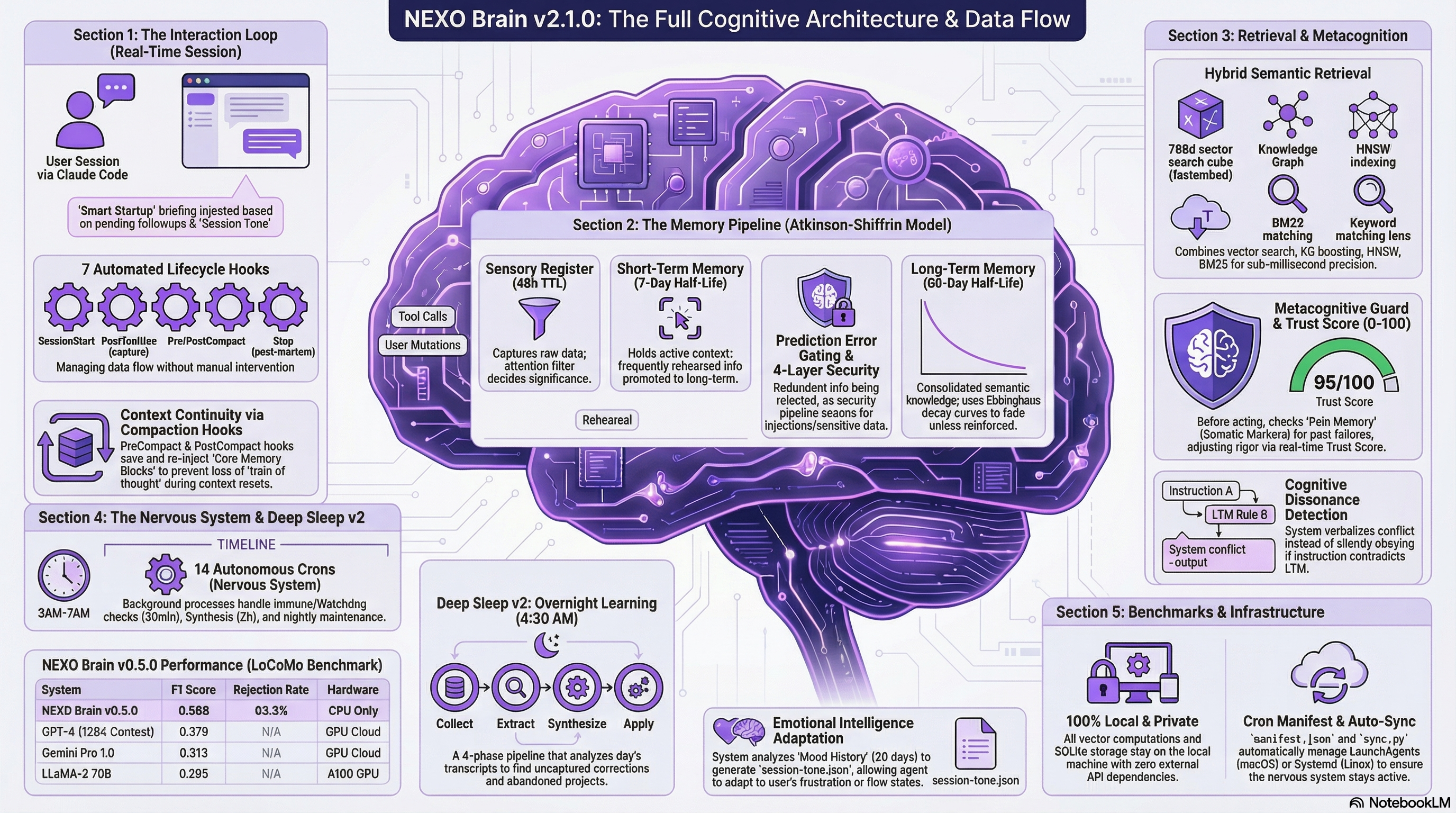
NEXO Brain implements the Atkinson-Shiffrin memory model from cognitive psychology (1968) — the same model that explains how human memory works:
What you say and do
    |
    +---> Sensory Register (raw capture, 48h)
    |       |
    |       +---> Attention filter: "Is this worth remembering?"
    |               |
    |               v
    +---> Short-Term Memory (7-day half-life)
    |       |
    |       +---> Used often? --> Consolidate to Long-Term Memory
    |       +---> Not accessed? --> Gradually forgotten
    |
    +---> Long-Term Memory (60-day half-life)
            |
            +---> Active: instantly searchable by meaning
            +---> Dormant: faded but recoverable ("oh right, I remember now!")
            +---> Near-duplicates auto-merged to prevent clutter
This isn't a metaphor. NEXO Brain literally implements Ebbinghaus forgetting curves, rehearsal-based reinforcement, and memory consolidation during automated "sleep" processes.
| Without NEXO Brain | With NEXO Brain |
|---|---|
| Memory gone after each session | Persistent across sessions with natural decay and reinforcement |
| Repeats the same mistakes | Checks "have I made this mistake before?" before every action |
| Keyword search only | Finds memories by meaning, not just words |
| Starts cold every time | Resumes from the mental state of the last session |
| Same behavior regardless of context | Adapts tone and approach based on your mood |
| No relationship | Trust score that evolves — makes fewer redundant checks as alignment grows |
| Stores everything blindly | Prediction error gating rejects redundant information at write time |
| Vulnerable to memory poisoning | 4-layer security pipeline scans every memory before storage |
| No proactive behavior | Context-triggered reminders fire when topics match, not just by date |
NEXO Brain uses Ebbinghaus forgetting curves — memories naturally fade over time unless reinforced by use. This isn't a bug, it's how useful memory works:
- A lesson learned yesterday is strong. If you never encounter it again, it fades — because it probably wasn't important.
- A lesson accessed 5 times in 2 weeks gets promoted to long-term memory — because repeated use proves it matters.
- A dormant memory can be reactivated if something similar comes up — the "oh wait, I remember this" moment.
On top of that baseline, NEXO now keeps a lightweight per-memory profile:
- stability slows decay for memories that keep surviving retrieval and reinforcement
- difficulty speeds decay slightly for memories that tend to be weak, noisy, or harder to reuse correctly
That keeps the core Ebbinghaus model, but makes decay more individual and less purely global.
NEXO Brain doesn't search by keywords. It searches by meaning using vector embeddings (fastembed, 768 dimensions).
Example: If you search for "deploy problems", NEXO Brain will find a memory about "SSH connection timeout on production server" — even though they share zero words. This is how human associative memory works.
Retrieval is now also smarter by default:
- HyDE auto mode expands conceptual or ambiguous queries when that improves recall
- Spreading activation auto mode adds a shallow associative boost for concept-heavy searches
- Exact lookup heuristics keep both off for literal file paths, IDs, stack traces, and other precision-sensitive queries
Before every code change, NEXO Brain asks itself: "Have I made a mistake like this before?"
It searches its memory for related errors, warnings, and lessons learned. If it finds something relevant, it surfaces the warning BEFORE acting — not after you've already broken production.
When you give an instruction that contradicts established knowledge, NEXO Brain doesn't silently obey or silently resist. It verbalizes the conflict:
"My memory says you prefer Tailwind over plain CSS, but you're asking me to write inline styles. Is this a permanent change or a one-time exception?"
You decide: paradigm shift (permanent change), exception (one-time), or override (old memory was wrong).
Some memories look identical but apply to different contexts. "How to deploy" for Project A is different from Project B. NEXO Brain detects discriminating entities (different OS, platform, language) and links them as siblings instead of merging them:
"Applying the Linux deploy procedure. Note: there's a sibling for macOS that uses a different port."
NEXO Brain tracks alignment with you through a trust score:
- You say thanks --> score goes up --> reduces redundant verification checks
- Makes a mistake you already taught it --> score drops --> becomes more careful, checks more thoroughly
- The score doesn't control permissions — you're always in control. It's a mirror that helps calibrate rigor.
NEXO Brain reads your tone (keywords, message length, urgency signals) and adapts:
- Frustrated? --> Ultra-concise mode. Zero explanations. Just solve the problem.
- In flow? --> Good moment to suggest that backlog item from last Tuesday.
- Urgent? --> Immediate action, no preamble.
Like a human brain, NEXO Brain has automated processes that run while you're not using it:
| Time | Process | Human Analogy |
|---|---|---|
| 03:00 | Decay + memory consolidation + merge duplicates + dreaming | Deep sleep consolidation |
| 04:00 | Clean expired data, prune redundant memories | Synaptic pruning |
| 07:00 | Self-audit, health checks, metrics | Waking up + orientation |
| 23:30 | Process day's events, extract patterns | Pre-sleep reflection |
| Boot | Catch-up: run anything missed while computer was off | -- |
If your Mac was asleep during any scheduled process, NEXO Brain catches up in order when it wakes.
Deep Sleep now also mixes recent context with older context across a 60-day horizon. Instead of only looking at the immediate past, it can surface:
- recurring multi-week themes
- cross-domain links between older learnings and current failures
- stale followups and topics that keep being mentioned but never formalized
- weighted project pressure based on diary activity, followups, learnings, and decision outcomes
It now also writes weekly and monthly Deep Sleep summaries so the overnight system can reuse higher-horizon signals instead of rediscovering everything from scratch every day.
The Cortex is a middleware cognitive layer that makes the agent think before acting. It implements architectural inhibitory control — the agent cannot bypass reasoning.
User message → Fast Path check → Simple chat? → Respond directly
                                → Action needed? → Cortex activates
                                                    ↓
                                              Generate cognitive state
                                              (goal, plan, unknowns, evidence)
                                                    ↓
                                              Middleware validates
                                              ├─ Unknowns? → ASK mode (tools blocked)
                                              ├─ No plan? → PROPOSE mode (read-only)
                                              └─ Plan + evidence → ACT mode (full access)
| Feature | What It Does |
|---|---|
| Inhibitory Control | Physically restricts tools based on reasoning quality. Unknowns → can only ask. No plan → can only propose. Evidence + verification → can act. |
| Event-Driven Activation | Only activates on tool intent, ambiguity, destructive actions, or retries. Simple chat has zero overhead. |
| Trust-Gated Escalation | Low trust score → requires more evidence before allowing "act" mode. Trust builds through successful execution. |
| Core Rules Injection | Automatically surfaces relevant behavioral rules based on task type. |
| Activation Metrics | Tracks modes, inhibition rates, and task types for continuous improvement. |
The Cortex was designed through a 3-way AI debate (Claude Opus 4.6 + GPT-5.4 + Gemini 3.1 Pro) and validated against 6 months of real production failures.
Memory and guardrails are not enough if long work still restarts from zero.
NEXO now ships a durable workflow runtime for multi-step and cross-session execution:
nexo_workflow_opencreates a persistent run with step metadata, idempotency key, priority, and shared statenexo_workflow_updaterecords replayable checkpoints, retry metadata, approval gates, and the current actionable statenexo_workflow_resumetells the agent what to do next without guessingnexo_workflow_replayreconstructs the recent execution history honestly instead of pretending the run is still in memorynexo_workflow_listkeeps active and blocked work visible so it does not disappear into reminders or prose notes
This is the bridge between "good memory" and "reliable execution": tasks can now preserve state, retries, approval gates, and next action across interruptions.
NEXO Brain automatically preserves session context when Claude Code compacts conversations. Using PreCompact and PostCompact hooks:
- PreCompact: Saves a complete session checkpoint to SQLite (task, files, decisions, errors, reasoning thread, next step)
- PostCompact: Re-injects a structured Core Memory Block into the conversation, so the session continues seamlessly
This means long sessions (8+ hours) feel like one continuous conversation instead of restarting after each compaction.
How it works:
- Configure the hooks in your Claude Code
settings.json - NEXO Brain's heartbeat automatically maintains the checkpoint
- When compaction happens, the PreCompact hook reads the checkpoint and injects a recovery block
- The session continues from exactly where it left off
Setup:
{
  "hooks": {
    "PreCompact": [{
      "matcher": "*",
      "hooks": [{"type": "command", "command": "bash $NEXO_HOME/hooks/pre-compact.sh", "timeout": 10}]
    }],
    "PostCompact": [{
      "matcher": "*",
      "hooks": [{"type": "command", "command": "bash $NEXO_HOME/hooks/post-compact.sh", "timeout": 10}]
    }]
  }
}
2 new MCP tools: nexo_checkpoint_save (manual or hook-triggered checkpoint), nexo_checkpoint_read (retrieves the latest checkpoint for context injection).
NEXO Brain provides 150+ MCP tools across 23 categories. These features implement cognitive science concepts that go beyond basic memory:
| Feature | What It Does |
|---|---|
| Prediction Error Gating | Only novel information is stored. Redundant content that matches existing memories is rejected at write time, keeping your memory clean without manual curation. |
| Security Pipeline | 4-layer defense against memory poisoning: injection detection, encoding analysis, behavioral anomaly scoring, and credential scanning. Every memory passes through all four layers before storage. |
| Quarantine Queue | New facts enter quarantine status and must pass a promotion policy before becoming trusted knowledge. Prevents unverified information from influencing decisions. Automated nightly processing promotes, rejects, or expires items. |
| Secret Redaction | Auto-detects and redacts API keys, tokens, passwords, and other sensitive data before storage. Secrets never reach the vector database. |
| Feature | What It Does |
|---|---|
| Pin / Snooze / Archive | Granular lifecycle states for memories. Pin = never decays (critical knowledge). Snooze = temporarily hidden (revisit later). Archive = cold storage (searchable but inactive). |
| Intelligent Chunking | Adaptive chunking that respects sentence and paragraph boundaries. Produces semantically coherent chunks instead of arbitrary token splits, reducing retrieval noise. |
| Adaptive Decay | Decay rate still follows Ebbinghaus as the base model, but now also adapts per memory using stability and difficulty profiles. Frequently reinforced memories become stickier; fragile memories fade sooner. |
| Auto-Migration | Formal schema migration system (schema_migrations table) tracks all database changes. Safe, reversible schema evolution for production systems — upgrades never lose data. |
| Auto-Merge Duplicates | Batch cosine deduplication during the 03:00 sleep cycle. Respects sibling discrimination — similar memories about different contexts are kept separate. |
| Memory Dreaming | Discovers hidden connections between recent memories during the 03:00 sleep cycle and now feeds a 60-day long-horizon Deep Sleep blend, so older patterns can reappear when they become relevant again. |
| Feature | What It Does |
|---|---|
| Hot Context 24h | Keeps active topics, blockers, and waiting states fresh across sessions, clients, cron ticks, and channel changes. This is the shared recent-memory substrate for operational continuity. |
| Pre-Action Context Bundle | Loads recent contexts, recent events, related reminders, and related followups before acting, so continuity is explicit instead of prompt-only. |
| Transcript Fallback | When recent-memory capture is thin or missing, NEXO can now search and read recent Claude Code / Codex transcripts directly through MCP instead of pretending the conversation is lost. |
| Live System Catalog | NEXO can now inspect its own current surface — core tools, plugin tools, skills, scripts, crons, projects, and artifacts — through a live catalog derived from canonical sources at read time. |
| Feature | What It Does |
|---|---|
| HyDE Query Expansion | Generates hypothetical answer embeddings for richer semantic search. NEXO now auto-enables HyDE for conceptual or ambiguous queries while keeping literal lookups conservative. |
| Hybrid Search (FTS5+BM25+RRF) | Combines dense vector search with BM25 keyword search via Reciprocal Rank Fusion. Outperforms pure semantic search on precise terminology and code identifiers. |
| Cross-Encoder Reranking | After initial vector retrieval, a cross-encoder model rescores candidates for precision. The top-k results are reordered by true semantic relevance before being returned to the agent. |
| Multi-Query Decomposition | Complex questions are automatically split into sub-queries. Each component is retrieved independently, then fused for a higher-quality answer — improves recall on multi-faceted prompts. |
| Temporal Indexing | Memories are indexed by time in addition to semantics. Time-sensitive queries ("what did we decide last Tuesday?") use temporal proximity scoring alongside semantic similarity. |
| Spreading Activation | Graph-based co-activation network. NEXO now auto-enables a shallow spreading pass for concept-heavy queries, improving contextual recall without turning every exact lookup into a fuzzy search. |
| Recall Explanations | Transparent score breakdown for every retrieval result. Shows exactly why a memory was returned: semantic similarity, recency, access frequency, and co-activation bonuses. |
| Feature | What It Does |
|---|---|
| Prospective Memory | Context-triggered reminders that fire when conversation topics match, not just by date. "Remind me about X when we discuss Y" works naturally. |
| Hook Auto-capture | Extracts decisions, corrections, and factual statements from conversations automatically. You don't need to explicitly say "remember this" — the system detects what's worth storing. |
| Session Summaries | Automatic end-of-session summarization that distills key decisions, errors, and follow-ups into a compact diary entry. The next session starts with full context — not a cold slate. |
| Smart Startup | Pre-loads relevant cognitive memories at session boot by composing a query from pending followups, due reminders, and last session's topics. Every session starts with the right context — not a cold search. |
| Context Packets | Bundles all area knowledge (learnings, recent changes, active followups, preferences, cognitive memories) into a single injectable packet for subagent delegation. Subagents never start blind again. |
| Auto-Prime by Topic | Heartbeat detects project/area keywords in conversation and automatically surfaces the most relevant learnings. No explicit memory query needed — context arrives proactively. |
NEXO Brain was evaluated on LoCoMo (ACL 2024), a long-term conversation memory benchmark with 1,986 questions across 10 multi-session conversations.
| System | F1 | Adversarial | Hardware |
|---|---|---|---|
| NEXO Brain v0.5.0 | 0.588 | 93.3% | CPU only |
| GPT-4 (128K full context) | 0.379 | — | GPU cloud |
| Gemini Pro 1.0 | 0.313 | — | GPU cloud |
| LLaMA-3 70B | 0.295 | — | A100 GPU |
| GPT-3.5 + Contriever RAG | 0.283 | — | GPU |
+55% vs GPT-4. Running entirely on CPU.
Key findings:
- Outperforms GPT-4 (128K full context) by 55% on F1 score
- 93.3% adversarial rejection rate — reliably says "I don't know" when information isn't available
- 74.9% recall across 1,986 questions
- Open-domain F1: 0.637 | Multi-hop F1: 0.333 | Temporal F1: 0.326
- Runs on CPU with 768-dim embeddings (BAAI/bge-base-en-v1.5) — no GPU required
- First MCP memory server benchmarked on a peer-reviewed dataset
Full results in benchmarks/locomo/results/.
NEXO Brain doesn't just respond — it runs 13 core recovery-aware background jobs plus optional helpers, like a biological nervous system. They handle maintenance, health monitoring, and self-improvement without any user interaction:
| Script | Schedule | What It Does |
|---|---|---|
| cognitive-decay | 03:00 daily | Ebbinghaus decay + memory consolidation + duplicate merging + dreaming |
| sleep | 04:00 daily | Synaptic pruning, expired data cleanup |
| deep-sleep | 04:30 daily | 4-phase overnight pipeline: Collect→Extract→Synthesize→Apply. Analyzes all sessions, detects emotional patterns, abandoned projects, productivity issues, and auto-creates learnings |
| self-audit | 07:00 daily | Health checks, guard stats, trust score review, metrics |
| postmortem | 23:30 daily | Session consolidation, extract patterns from day's events |
| catchup | On boot | Runs any missed scheduled processes (Mac was off/asleep) |
| tcc-approve | On boot (macOS) | Auto-approve macOS permissions for Claude Code updates |
| prevent-sleep | Always (daemon) | Keeps machine awake for nocturnal processes (caffeinate/systemd-inhibit) |
| evolution | Weekly (Sun) | Self-improvement proposals — NEXO suggests and applies enhancements |
| followup-hygiene | Weekly (Sun) | Normalizes statuses, flags stale followups, cleans orphans |
| learning-housekeep | 03:15 daily | Dedup learnings, adjust weights by usage, process overdue reviews, reconcile decision outcomes |
| immune | Every 30 min | Quarantine processing, memory promotion/rejection, synaptic pruning |
| impact-scorer | 05:45 daily | Scores active followups so queues can prioritize by expected impact |
| synthesis | 06:00 daily | Memory synthesis — discovers cross-memory patterns |
| outcome-checker | 08:00 daily | Verifies tracked outcomes and marks them met, pending, or missed |
| watchdog | Every 30 min | Monitors services, LaunchAgents, and infrastructure health |
| auto-close-sessions | Every 5 min | Cleans stale sessions |
Core processes are defined in src/crons/manifest.json and auto-synced to your system by nexo_update. On macOS they run via LaunchAgents; on Linux via systemd user timers. tcc-approve, prevent-sleep, and backup are platform/personal helpers — not in the manifest but listed above for completeness. Personal crons (your own scripts) are never touched by the sync. If your Mac was asleep during a scheduled process, the catch-up script re-runs everything in order when it wakes.
Deep Sleep is a 4-phase pipeline that runs at 4:30 AM and makes NEXO smarter while you sleep:
Phase 1: COLLECT (Python)
├── Reads all session transcripts from the day
├── Splits each session into individual .txt files
└── Gathers DB state (followups, learnings, trust)

Phase 2: EXTRACT (Opus, one call per session)
├── 8 types of findings per session:
│   ├── Uncaptured corrections (user corrected agent, no learning saved)
│   ├── Self-corrected errors (knowledge gaps to fix)
│   ├── Unformalised ideas (mentioned but never tracked)
│   ├── Missed commitments (promised but no followup)
│   ├── Protocol violations (guard_check, heartbeat, change_log)
│   ├── Emotional signals (frustration, flow, satisfaction)
│   ├── Abandoned projects (started but not finished)
│   └── Productivity patterns (corrections, proactivity, tool efficiency)
└── Outputs per-session JSON with findings + emotional timeline

Phase 3: SYNTHESIZE (Opus, one call)
├── Cross-session patterns (same error in 5 sessions = systemic)
├── Daily mood arc with score (0.0 = terrible day, 1.0 = great day)
├── Recurring triggers (what causes frustration vs flow)
├── Productivity analysis (corrections, tool efficiency)
├── Abandoned project detection
├── Morning agenda (prioritized)
└── Calibration recommendations

Phase 4: APPLY (Python)
├── Auto-creates learnings from high-confidence findings
├── Creates followups for unfinished work
├── Updates mood_history in calibration.json (30-day rolling)
├── Generates session-tone.json (emotional guidance for next session)
└── Writes morning-briefing.md
Deep Sleep generates a session-tone.json that tells NEXO how to behave next morning:
- Agent made many mistakes yesterday → Acknowledge them, show what was learned, demonstrate improvement
- User had a bad day (mood < 40%) → Supportive approach, lighter start, avoid known frustration triggers
- User had a great day (mood > 70%) → Reinforce momentum, reference wins, push ambitious goals
- Agent was too reactive → Be proactive today, don't wait for instructions
This is read by nexo_smart_startup and injected into every session's context. NEXO adapts its personality based on real behavioral data, not just configuration.
All core crons are defined in src/crons/manifest.json. When you run nexo_update, the sync script:
- Installs new crons from the manifest
- Updates changed schedules/intervals
- Removes crons no longer in the manifest (only core ones)
- Never touches personal crons you created yourself
Every cron execution is tracked in the cron_runs table via a universal wrapper. Use nexo_schedule_status to see what ran overnight:
✅ deep-sleep: 1/1 OK, 4523s avg — 37 sessions, 259 findings
✅ immune: 48/48 OK, 2s avg
❌ evolution: 0/1 OK — CLI timeout
Add personal crons from conversation with nexo_schedule_add — generates LaunchAgent (macOS) or systemd timer (Linux) automatically.
Deep Sleep automatically extracts reusable procedures from successful multi-step tasks and stores them as skills with full procedural content (steps, gotchas, markdown).
Pipeline: trace → draft → published → archived. Trust rises with successful use, decays without it. No human approval gates.
7 MCP tools: nexo_skill_create, nexo_skill_match, nexo_skill_get, nexo_skill_result, nexo_skill_list, nexo_skill_merge, nexo_skill_stats.
A web interface at localhost:6174 with 6 interactive pages for visual insight into your brain's state:
| Page | What It Shows |
|---|---|
| Overview | System health at a glance — memory counts, trust score, active sessions, recent changes |
| Graph | Interactive D3.js visualization of the knowledge graph (nodes, edges, clusters) |
| Memory | Browse and search all memory stores (STM, LTM, sensory, archived) |
| Somatic | Pain map per file/area — see which parts of your codebase cause the most errors |
| Adaptive | Personality signals, learned weights, and current mode |
| Sessions | Active and historical sessions with timeline and diary entries |
Built with FastAPI backend and D3.js frontend. Dashboard files are installed to NEXO_HOME/dashboard/ but must be started manually:
python3 ~/.nexo/dashboard/app.pyThis opens localhost:6174 in your browser. Add --port 8080 to change the port or --no-browser to skip auto-opening.
Memory alone doesn't make a co-operator. What makes the difference is the behavioral loop — the automated discipline that ensures every session starts informed, runs with guardrails, and ends with self-reflection.
7 hooks fire automatically at key moments in every Claude Code session:
| Hook | When | What It Does |
|---|---|---|
| SessionStart (timestamp) | Session opens | Writes session timestamp for staleness detection |
| SessionStart (briefing) | Session opens | Generates briefing from SQLite: overdue reminders, today's tasks, pending followups, active sessions. Cleans up post-mortem flags. |
| Stop | Session ends | Mandatory post-mortem: self-critique (5 questions), session buffer entry, followup creation, proactive seeds for next session |
| PostToolUse (capture) | After each tool call | Captures meaningful mutations to the Sensory Register + auto-diary every 10 tool calls |
| PostToolUse (inbox) | After each tool call | Inter-terminal inbox delivery between parallel sessions |
| PreCompact | Before context compression | Saves full session checkpoint to SQLite — task, files, decisions, errors, reasoning thread + emergency diary |
| PostCompact | After context compression | Re-injects Core Memory Block so the session continues seamlessly from where it left off |
Session starts
    ↓
SessionStart hook generates briefing
    ↓
Operator reads diary, reminders, followups
    ↓
Heartbeat on every interaction (sentiment, context shifts)
    ↓
Guard check before every code edit
    ↓
PreCompact hook saves full checkpoint if conversation is compressed
    ↓
PostCompact hook re-injects Core Memory Block → session continues seamlessly
    ↓
Stop hook refreshes the diary draft and approves immediately:
  - Latest changes and decisions stay attached to the active session
  - Session buffer keeps structured tool activity for downstream processing
  - Followups and closing synthesis happen inline when the agent detects real closing intent
  - No mid-conversation blocking from the hook itself
    ↓
Nocturnal post-mortem consolidator processes the buffer mechanically
    ↓
Nocturnal processes: decay, consolidation, self-audit, dreaming
NEXO still ships nexo-reflection.py as a standalone analyzer for session_buffer.jsonl.
It is not currently auto-triggered by the stop hook:
- Extracts recurring tasks, error patterns, mood trends
- Updates
user_model.jsonwith observed behavior - No LLM required — runs as pure Python
Existing users upgrading from any previous version:
npx nexo-brain # detects current version, migrates automatically- Updates hooks, core files, plugins, scripts, and LaunchAgent templates
- Runs database schema migrations automatically
- Never touches your data (memories, learnings, preferences)
- Saves updated CLAUDE.md as reference (doesn't overwrite customizations)
NEXO Brain includes a local CLI that runs independently of any single terminal client:
nexo chat— launch a NEXO terminal client; if both Claude Code and Codex are available, it asks every time which one to open and puts the last-used client firstnexo update— sync runtime from source, run migrations, reconcile schedulesnexo doctor --tier runtime— boot/runtime/deep diagnostics with--fixmodenexo scripts list— list all personal scripts and their statusnexo scripts reconcile— align declared schedules with actual LaunchAgents/systemdnexo -v— show installed runtime version
The CLI lives at NEXO_HOME/bin/nexo and is added to your PATH during install.
Scripts in NEXO_HOME/scripts/ are first-class managed entities:
- Tracked in SQLite with metadata, categories, and schedule associations
- Inline metadata in scripts declares name, runtime, schedule, and recovery policy
nexo scripts create NAMEscaffolds a new script with the correct templatenexo scripts reconcilecreates/repairs LaunchAgents from declared metadatanexo scripts syncdiscovers filesystem state and updates the registrynexo doctor --tier runtimedetects orphaned schedules, missing plists, and drift
Personal scripts are completely separate from core NEXO processes. The crons/manifest.json defines core; everything in NEXO_HOME/scripts/ is personal.
If you need to decide between a personal script, skill, plugin, or schedule, use docs/personal-artifacts-manual.md. That is the canonical operational guide.
Core and personal jobs now declare explicit recovery contracts in crons/manifest.json:
| Field | Purpose |
|---|---|
recovery_policy |
catchup, restart, restart_daemon, or skip |
run_on_boot |
Re-run when the machine starts |
run_on_wake |
Re-run after sleep/resume |
idempotent |
Safe to re-run without side effects |
max_catchup_age |
Maximum age of a missed window to still catch up |
If the Mac was asleep during a scheduled window, catchup detects the gap from cron_runs (not a state file) and re-executes eligible jobs once. Interval-based personal scripts get a single recovery run, not repeated ticks.
For personal daemon-style helpers, recovery_policy=restart_daemon plus schedule_required=true declares an official KeepAlive schedule. NEXO can now reconcile and repair those daemons instead of treating them as unmanaged legacy LaunchAgents.
Before nexo chat or MCP server start, NEXO runs a preflight check:
- Apply power policy (caffeinate on macOS, systemd-inhibit on Linux)
- Run safe local migrations and backfills
- Sync personal scripts registry
- For dev-linked runtimes: check if source repo is behind, pull if safe, sync to runtime
This replaces the old "blind startup" where NEXO entered without verifying runtime health.
A bi-temporal entity-relationship graph with 988 nodes and 896 edges. Entities and relationships carry both valid-time (when the fact was true) and system-time (when it was recorded), enabling temporal queries like "what did we know about X last Tuesday?". BFS traversal discovers multi-hop connections between concepts. Event-sourced edges with smart dedup (ADD/UPDATE/NOOP) prevent redundant writes while preserving full history.
4 MCP tools: nexo_kg_query (SPARQL-like queries), nexo_kg_path (shortest path between entities), nexo_kg_neighbors (direct connections), nexo_kg_stats (graph metrics).
Full Linux support and Windows via WSL. The installer detects the platform and configures the appropriate process manager (LaunchAgents on macOS, catch-up on startup for Linux). PEP 668 compliance (venv on Ubuntu 24.04+). Session keepalive prevents phantom sessions during long tasks. Opportunistic maintenance runs cognitive processes when resources are available.
Windows users: NEXO Brain requires WSL (Windows Subsystem for Linux). Install WSL first, then run
npx nexo-braininside the Ubuntu/WSL terminal.
A new abstraction layer routes storage operations through a unified interface, making the system multi-tenant ready. Each operator's data is isolated while sharing the same cognitive engine.
Signal weights learn from real user feedback via Ridge regression. A 2-week shadow mode observes before activating. Weight momentum (85/15 blend) prevents personality whiplash. Automatic rollback if correction rate doubles.
Files and areas that cause repeated errors accumulate a risk score (0.0–1.0). The guard system warns on HIGH RISK (>0.5) and CRITICAL RISK (>0.8), lowering thresholds for more paranoid checking. Clean guard checks reduce risk multiplicatively (×0.7). Nightly decay (×0.95) ensures old pain fades.
6 weighted signals: vibe, corrections, brevity, topic, tool errors, git diff. Emergency keywords bypass hysteresis. Severity-weighted decay. Manual override via nexo_adaptive_override.
npx nexo-brainThe installer handles everything and syncs the same nexo MCP brain into Claude Code, Claude Desktop, and Codex when those clients are present:
  How should I call myself? (default: Nova) > Atlas

  Can I explore your workspace to learn about your projects? (y/n) > y

  Keep Mac awake so my cognitive processes run on schedule? (y/n) > y

  Installing cognitive engine dependencies...
  Setting up NEXO home...
  Scanning workspace...
    - 3 git repositories
    - Node.js project detected
  Configuring MCP server...
  Setting up nervous system...
    15 core recovery-aware jobs configured.
    Dashboard configured at localhost:6174.
  Caffeinate enabled.
  Generating operator instructions...

  +----------------------------------------------------------+
  |  Atlas is ready. Type 'atlas' to start.                  |
  +----------------------------------------------------------+
NEXO now ships a root-level docker-compose.yml for a persistent containerized runtime. It does two things at once:
- keeps
NEXO_HOMEon a named volume - exposes a remote MCP endpoint at
http://localhost:8000/mcpfor IDEs that support HTTP/SSE MCP
Start it with:
docker compose up -dFor Claude Code and Codex, keep using stdio and point the MCP command at the running container:
docker compose exec -T nexo python src/server.pyThat gives you the same persistent brain in the container while keeping terminal clients on their native stdio transport. The full step-by-step flow, health checks, and config examples live in docs/docker-setup.md.
After install, use the runtime CLI:
nexo chat          # Launch a NEXO terminal client (asks if both Claude Code and Codex are available)
nexo doctor        # Check runtime health
nexo update        # Pull latest version and sync
nexo clients sync  # Re-sync Claude Code/Desktop/Codex to the same brain
nexo scripts list  # See your personal scripts
During install, NEXO now asks which interactive clients you want to connect, which one nexo chat should suggest first when multiple terminal clients are available, whether to enable background automation, which backend should run that automation, and which model profile each active terminal/backend should use. Shared brain stays on in every mode.
Public entry points for the mental model now stay intentionally small:
nexo_remembernexo_memory_recallnexo_consolidatenexo_run_workflownexo_pre_action_contextnexo_transcript_searchnexo_system_catalog
If you want the shell or Python wrappers instead of raw MCP tools:
- docs/quickstart-5-minutes.md
- docs/memory-classes.md
- docs/recent-memory-fallbacks-and-system-catalog.md
- docs/sdk-python.md
- docs/reference-verticals.md
- compare/README.md
The model you pick during install is used everywhere — interactive sessions, automation scripts, and all task profiles. Change it once in your preferences and every part of the system follows. Default: Opus 4.7 with 1M context.
Or use the shell alias created during install (e.g. atlas), which now runs nexo chat . so it opens the terminal client you pick for that session, with the last-used option shown first.
Your operator will greet you immediately — adapted to the time of day, resuming from where you left off. No cold starts.
NEXO is being hardened in public, and the best contributions now are not only code changes but also real workflow feedback:
- Open issues when a client flow feels asymmetric across Claude Code, Codex, Claude Desktop, OpenClaw, or other MCP environments.
- Send PRs for docs, install UX, tests, compatibility checks, and public-facing copy.
- If you use NEXO in production-like daily work, include exact runtime symptoms and commands in bug reports. This project improves fastest when the operational reality is concrete.
The project still recommends Claude Code as the primary path, but contributions that improve Codex, client parity, installer clarity, and ecosystem integrations are especially valuable.
Maintainers and contributors touching startup, bootstrap, Deep Sleep, or shared-brain behavior should also use the client parity checklist:
- docs/client-parity-checklist.md
python3 scripts/verify_release_readiness.py
| Component | What | Where |
|---|---|---|
| Cognitive engine | Python: fastembed, numpy, vector search | pip packages |
| MCP server | 150+ tools for memory, cognition, learning, guard | NEXO_HOME/ |
| Claude Code Plugin | Marketplace-ready (packaging verified) | .claude-plugin/ |
| Plugins | Guard, episodic memory, cognitive memory, entities, preferences, update, etc. | Code: src/plugins/, Personal: NEXO_HOME/plugins/ |
| Hooks (7) | SessionStart, Stop, PostToolUse, PreCompact, PostCompact | NEXO_HOME/hooks/ |
| Nervous system | 13 core recovery-aware jobs + optional helpers (dashboard, prevent-sleep) | NEXO_HOME/scripts/ |
| Dashboard | Web UI at localhost:6174 (23 modules, dark theme) — opt-in, always-on | NEXO_HOME/dashboard/ |
| Runtime CLI | nexo command: scripts, doctor, skills, update |
NEXO_HOME/bin/ |
| Doctor | Unified diagnostics: boot/runtime/deep tiers, --fix mode |
src/doctor/ |
| Skills v2 | Executable skills with guide/execute/hybrid modes, approval levels | NEXO_HOME/skills/ |
| Startup Preflight | Health checks before every nexo chat or server start |
Built into CLI |
| CLAUDE.md | Complete operator instructions (Codex, hooks, guard, trust, memory) | ~/.claude/CLAUDE.md |
| Schedule config | schedule.json with customizable process times and timezone | NEXO_HOME/config/ |
| Auto-update | Non-blocking startup check (5s max), opt-out via schedule.json | Built into server startup |
| CLAUDE.md tracker | Version-tracked core sections with safe updates preserving customizations | Built into auto-update |
| Shared client sync | Same nexo MCP entry wired into Claude Code, Claude Desktop, and Codex |
User config dirs |
| Client/backend preferences | Selected interactive clients, default terminal client, automation backend, and model/reasoning profiles per client | NEXO_HOME/config/schedule.json |
| Auto-diary | 3-layer system: PostToolUse every 10 calls, PreCompact emergency, heartbeat DIARY_OVERDUE | Built into hooks |
| Claude Code config | MCP server + 7 hooks + 15 managed processes registered | ~/.claude/settings.json |
After installation or auto-update, NEXO adds NEXO_HOME/bin to your shell PATH. Open a new terminal and the nexo command provides operational tools:
# Personal Scripts
nexo scripts list              # List your personal scripts
nexo scripts run my-script     # Run a script with injected NEXO env
nexo scripts doctor            # Validate all personal scripts
nexo scripts call nexo_learning_search --input '{"query":"cron"}' # Call any MCP tool

# Skills v2
nexo skills sync               # Sync filesystem skill definitions into SQLite
nexo skills list               # List published/stable skills
nexo skills get SK-...         # Inspect a skill definition
nexo skills apply SK-... --dry-run --json  # Resolve guide/execute/hybrid without running it
nexo skills approve SK-... --execution-level local --approved-by Francisco  # Optional metadata override
nexo skills evolution          # Show text→script and improvement candidates

# Unified Doctor
nexo doctor                    # Quick boot diagnostics
nexo doctor --tier all         # Full system check (boot + runtime + deep)
nexo doctor --tier runtime --json  # Machine-readable health report
nexo doctor --fix              # Apply deterministic repairs
Personal scripts live in NEXO_HOME/scripts/ with inline metadata. Their Python templates now include run_automation_text(...), which routes work through the configured NEXO automation backend instead of hardcoding claude -p or provider-specific model names. nexo-agent-run.py now also supports task profiles (fast, balanced, deep) plus safe backend fallback, so automations can prefer cheaper/faster Codex paths or deeper Claude paths without hardcoding one provider forever. See docs/writing-scripts.md for details and docs/personal-artifacts-manual.md for the canonical artifact decision guide.
Skills v2 combine procedural guides with optional executable scripts. Personal skills live in NEXO_HOME/skills/, packaged core skills live in NEXO_CODE/skills/ during development and NEXO_HOME/skills-core/ in installed environments, and staged runtime copies live in NEXO_HOME/skills-runtime/. Execution is fully autonomous: Deep Sleep can evolve mature guide skills into executable drafts automatically, and runtime execution no longer waits for manual approval. See docs/skills-v2.md for the full model and docs/personal-artifacts-manual.md for the boundary between skills, scripts, plugins, and schedules.
The Doctor system reads existing health artifacts (immune, watchdog, self-audit) without triggering repairs in default mode.
- macOS or Linux (Windows via WSL)
- Node.js 18+ (for the installer)
- Claude Code is the primary recommended client. It remains the most mature NEXO path: native hooks, the most battle-tested automation contract, and the clearest parity with historical production behavior.
- Model: You pick your model during install and every component uses it. Default is
Opus 4.7 with 1M context. Scripts and automation profiles read from a single preference — no hardcoded model strings. - Python 3, Homebrew, and the selected required client/backend can be installed automatically when NEXO has a supported installer path for that dependency.
NEXO Brain separates code (immutable, in the repo or npm package) from data (personal, in NEXO_HOME):
| Path | Contents |
|---|---|
src/ (or npm package) |
Server, plugins, hooks, scripts — never modified at runtime |
NEXO_HOME/ (default ~/.nexo/) |
Database, config, personal plugins, schedule, backups |
NEXO_HOME/config/schedule.json |
Customizable process schedules, timezone, auto_update flag |
NEXO_HOME/plugins/ |
Personal plugins that override or extend repo plugins |
NEXO_HOME/data/ |
SQLite databases (nexo.db, cognitive.db), migration state |
The plugin loader scans src/plugins/ first (base), then NEXO_HOME/plugins/ (personal override by filename). This dual-directory approach lets you extend NEXO without forking the repo.
The client sync layer points Claude Code, Claude Desktop, and Codex at the same runtime and NEXO_HOME, so all three clients share one brain instead of drifting into separate local memories.
| Category | Count | Tools | Purpose |
|---|---|---|---|
| Cognitive | 8 | retrieve, stats, inspect, metrics, dissonance, resolve, sentiment, trust | The brain — memory, RAG, trust, mood |
| Cognitive Input | 5 | prediction_gate, security_scan, quarantine, promote, redact | Input pipeline — gating, security, quarantine |
| Cognitive Advanced | 8 | hyde_search, spread_activate, explain_recall, dream, prospect, hook_capture, pin, archive | Advanced retrieval, proactive, lifecycle |
| Guard | 3 | check, stats, log_repetition | Metacognitive error prevention |
| Episodic | 10 | change_log/search/commit, decision_log/outcome/search, review_queue, diary_write/read, recall | What happened and why |
| Sessions | 4 | startup, heartbeat, stop, status | Session lifecycle + context shift detection + inter-terminal auto-inbox |
| Coordination | 7 | track, untrack, files, send, ask, answer, check_answer | Multi-session file coordination + messaging |
| Reminders | 5 | list, create, update, complete, delete | User's tasks and deadlines |
| Followups | 4 | create, update, complete, delete | System's autonomous verification tasks |
| Learnings | 5 | add, search, update, delete, list | Error patterns and prevention rules |
| Credentials | 5 | create, get, update, delete, list | Local credential storage (plaintext SQLite — protect with filesystem permissions) |
| Task History | 3 | log, list, frequency | Execution tracking and overdue alerts |
| Menu | 1 | menu | Operations center with box-drawing UI |
| Entities | 5 | search, create, update, delete, list | People, services, URLs |
| Preferences | 4 | get, set, list, delete | Observed user preferences |
| Agents | 5 | get, create, update, delete, list | Agent delegation registry |
| Backup | 3 | now, list, restore | SQLite data safety |
| Evolution | 5 | propose, approve, reject, status, history | Self-improvement proposals |
| Adaptive & Somatic | 4 | adaptive_weights, adaptive_override, somatic_check, somatic_stats | Learned signal weights + pain memory per file |
| Knowledge Graph | 4 | kg_query, kg_path, kg_neighbors, kg_stats | Bi-temporal entity-relationship graph |
| Context Continuity | 2 | checkpoint_save, checkpoint_read | Auto-compaction session preservation |
| Personal Scripts | 9 | sync, list, create, remove, schedules, unschedule, reconcile, classify, ensure_schedules | Script lifecycle management |
| Skills | 12 | match, create, get, list, apply, approve, result, stats, evolution_candidates, merge, sync, featured | Reusable procedure library |
| Schedule | 2 | add, status | Personal cron scheduling |
| Doctor | 1 | doctor | Runtime diagnostics with --fix |
| Update | 1 | update | Pull latest code, backup, migrate, verify (with rollback) |
NEXO Brain supports hot-loadable plugins with a dual-directory loader. Base plugins live in src/plugins/ (repo). Personal plugins go in NEXO_HOME/plugins/ and can override base plugins by filename. Drop a .py file in NEXO_HOME/plugins/:
# my_plugin.py
def handle_my_tool(query: str) -> str:
    """My custom tool description."""
    return f"Result for {query}"

TOOLS = [
    (handle_my_tool, "nexo_my_tool", "Short description"),
]
Reload without restarting: nexo_plugin_load("my_plugin.py")
Use a personal plugin only when you need a new MCP tool in the runtime surface. If the real need is autonomous execution or scheduling, use a personal script plus managed schedule instead. The canonical decision guide is docs/personal-artifacts-manual.md.
- Everything stays local. All data in
~/.nexo/, never uploaded anywhere. - No telemetry. No analytics. No phone-home.
- No cloud dependencies. Vector search runs on CPU (fastembed), not an API.
- Auto-update is resilient. NEXO checks for updates on startup. If an update fails, it continues with the current version and notifies you. Local migrations (database schema, configuration) always run. Network updates (git pull) can be disabled by setting
auto_update: falseinNEXO_HOME/config/schedule.json. - Secret redaction. API keys and tokens are stripped before they ever reach memory storage.
NEXO Brain isn't just engineering — it's applied cognitive psychology:
| Psychological Concept | How NEXO Brain Implements It |
|---|---|
| Atkinson-Shiffrin (1968) | Three memory stores: sensory register --> STM --> LTM |
| Ebbinghaus Forgetting Curve (1885) | Exponential decay: strength = strength * e^(-lambda * time) |
| Rehearsal Effect | Accessing a memory resets its strength to 1.0 |
| Memory Consolidation | Nightly process promotes frequently-used STM to LTM |
| Prediction Error | Only surprising (novel) information gets stored — redundant input is gated |
| Spreading Activation (Collins & Loftus, 1975) | Retrieving a memory co-activates related memories through an associative graph |
| HyDE (Gao et al., 2022) | Hypothetical document embeddings improve semantic recall |
| Prospective Memory (Einstein & McDaniel, 1990) | Context-triggered intentions fire when cue conditions match |
| Metacognition | Guard system checks past errors before acting |
| Cognitive Dissonance (Festinger, 1957) | Detects and verbalizes conflicts between old and new knowledge |
| Theory of Mind | Models user behavior, preferences, and mood |
| Synaptic Pruning | Automated cleanup of weak, unused memories |
| Associative Memory | Semantic search finds related concepts, not just matching words |
| Memory Reconsolidation | Dreaming process discovers hidden connections during sleep |
NEXO Brain is designed as an MCP server. Claude Code remains the primary recommended client and the most complete integration path:
npx nexo-brainAll 150+ tools are available immediately after installation. The installer configures Claude Code's ~/.claude/settings.json automatically. The recommended Claude profile is Opus 4.7 with 1M context.
When Claude Desktop is installed, nexo-brain, nexo update, and nexo clients sync keep claude_desktop_config.json pointed at the same local NEXO runtime and NEXO_HOME.
When Codex CLI is available, nexo-brain, nexo update, and nexo clients sync register the same nexo MCP server via codex mcp add, so Codex uses the same local memory store as Claude Code and Claude Desktop. If selected during install, nexo chat can open Codex directly and background automation can also run through Codex. Interactive nexo chat launches use Codex's aggressive no-confirmation mode so the session does not stall on repetitive approval prompts. Codex uses the same model you configured during install — no separate model override is needed. Runtime Doctor also audits recent Codex sessions for NEXO startup markers and conditioned-file protocol discipline so parity drift does not hide behind the lack of native Claude-style hooks.
Cursor works well as a documented companion client. Point Cursor at the same local nexo MCP server and add a project rule that forces nexo_startup, nexo_heartbeat, and the protocol path on real work. See docs/integrations/cursor.md.
Windsurf/Cascade supports MCP plus durable repo rules. Use the same local nexo server and add NEXO startup/protocol instructions in .windsurf/rules/ or your repo AGENTS.md. See docs/integrations/windsurf.md.
Gemini CLI can share the same local NEXO brain through mcpServers in ~/.gemini/settings.json plus a repo GEMINI.md. NEXO now ships a starter adapter in adapters/gemini/README.md.
NEXO Brain also works as a cognitive memory backend for OpenClaw:
Add NEXO Brain to your OpenClaw config at ~/.openclaw/openclaw.json:
{
  "mcp": {
    "servers": {
      "nexo-brain": {
        "command": "python3",
        "args": ["~/.nexo/server.py"],
        "env": {
          "NEXO_HOME": "~/.nexo"
        }
      }
    }
  }
}
Or via CLI:
openclaw mcp set nexo-brain '{"command":"python3","args":["~/.nexo/server.py"],"env":{"NEXO_HOME":"~/.nexo"}}'
openclaw gateway restartnpx clawhub@latest install nexo-brainnpm install @wazionapps/openclaw-memory-nexo-brain{
"plugins": {
"slots": {
"memory": "memory-nexo-brain"
}
}
}This replaces OpenClaw's default memory system with NEXO Brain's full cognitive architecture.
NEXO Brain works with any application that supports the MCP protocol. Configure it as an MCP server pointing to server.py inside NEXO_HOME (default ~/.nexo/server.py), with the NEXO_HOME env var set to the same directory.
| Directory | Type | Link |
|---|---|---|
| npm | Package | nexo-brain |
| Glama | MCP Directory | glama.ai |
| mcp.so | MCP Directory | mcp.so |
| mcpservers.org | MCP Directory | mcpservers.org |
| OpenClaw | Native Plugin | openclaw.com |
| dev.to | Technical Article | How I Applied Cognitive Psychology to AI Agents |
| Claude Code | Plugin (marketplace-ready) | Packaging verified, included in npm tarball |
| nexo-brain.com | Official Website | nexo-brain.com |
If NEXO Brain is useful to you, consider:
- Star this repo — it helps others discover the project and motivates continued development
- Sponsor on GitHub — support ongoing development directly
- Share your experience — tell others how you're using cognitive memory in your AI workflows
- Contribute — see CONTRIBUTING.md for guidelines. Issues and PRs welcome
- Client parity / shared-brain maintenance — see docs/client-parity-checklist.md
- Writing a personal script that calls the automation backend — see docs/personal-scripts-guide.md
The full harness is in benchmarks/README.md. The first checked-in micro-benchmark compares the NEXO runtime against a static CLAUDE.md-only baseline on five recall-heavy scenarios:
| Scenario | NEXO full stack | Static CLAUDE.md |
No memory |
|---|---|---|---|
| Decision rationale recall | Pass | Partial | Fail |
| User preference recall | Pass | Partial | Fail |
| Repeat-error avoidance | Pass | Partial | Fail |
| Resume interrupted task | Pass | Partial | Fail |
| Related-context stitching | Pass | Fail | Fail |
See benchmarks/results/memory-recall-vs-static.md for the rubric, prompt shape, and first-run notes.
- Restored Python 3.10 compatibility by replacing Python 3.11-only
datetime.UTCwithtimezone.utc. - Added
tomllib→tomlifallback plus declared runtime dependency for Python < 3.11. - Boot doctor now validates all critical JSON config artifacts:
schedule.json,optionals.json,crons/manifest.json.
- Protocol discipline runtime: Enforceable
nexo_task_open/nexo_task_close, persistentprotocol_debt,Cortexgates with durablecheck_id, conditioned-file guardrails across Claude hooks and Codex transcript audits. - Durable workflow runtime:
nexo_workflow_open/update/resume/replay/listwith persistent runs, steps, checkpoints, replay history, retry bookkeeping, and idempotent open keys. - Durable goals:
nexo_goal_open/update/get/listfor long-running work that stays active/blocked/abandoned/completed. - Operational truth: Deep Sleep survives schema drift,
keep_alivereports alive/degraded/duplicated honestly, warning storms no longer count as healthy. - Measured product surface: 5-minute quickstart, Python SDK, reference verticals, measured compare scorecard with LoCoMo baselines and
cost_per_solved_task. - Skill lifecycle: Testing, promotion, retirement, and composition flows. Evolution public-core peer-review for opt-in PRs.
- Managed Claude Code + Codex bootstrap with explicit
CORE/USERcontract. - Codex config sync and transcript-aware Deep Sleep across both clients.
- 60-day long-horizon analysis, weekly/monthly summary artifacts.
- Retrieval auto-mode and first measured engineering loop.
nexo chatopens the configured client instead of assuming Claude Code.
- Release artifact sync: Automated version synchronization across Claude Code plugin, OpenClaw package, and ClawHub skill before every publish.
- CI/CD pipeline: Full GitHub Actions workflow for publish + verification of all integration channels.
- OpenClaw plugin hardened: Contract tests, correct runtime path, synchronized version. Published as @wazionapps/openclaw-memory-nexo-brain@2.6.9.
- ClawHub skill hardened: Version-synced metadata, correct server path, post-publish smoke verification.
- Claude Code plugin packaging: Verified plugin.json, .mcp.json, hooks included in npm tarball. Marketplace-ready.
- Power helper semantics explicit and safer:
always_on= platform helper for best-effort background availability. - Catch-up recovery suppresses duplicate relaunches for in-flight
cron_runs. - Runtime update/startup reconciles declared personal schedules automatically.
- Runtime cron sync skips same-file copies, avoiding
SameFileErroron synced runtimes. - Core hook migration normalizes legacy flat entries into Claude Code's required
matcher + hooks[]format.
- Startup preflight before
nexo chatand server — safe local migrations, deferred remote updates. - Personal managed schedules can declare recovery contracts (wake/boot/catchup).
- Persisted runtime power policy (
always_on/disabled/unset). Installer andnexo updateprompt once. - Packaged installs resolve update root correctly (fixes
vunknown).
- Personal scripts registry: Scripts in
NEXO_HOME/scripts/tracked in SQLite with metadata, categories, schedules. Full lifecycle: create, sync, reconcile, schedule, unschedule, remove. - Orchestrator removed from core (breaking): Was opt-in personal automation adding complexity for all users. Existing users keep their setup in
NEXO_HOME/scripts/. - Claude Code plugin structure:
plugin.json, entry point, packaging for marketplace submission. nexo chat: Official command to launch a NEXO terminal client, asking when multiple supported terminal clients are available.- Managed Evolution hardening: Can modify core behavior modules with rollback followups.
- Cron recovery hardened: TCC diagnostics, keepalive sync, personal schedule catchup.
- Runtime CLI (
nexo): New operational CLI separate from installer.nexo scripts list/run/doctor/callfor personal scripts,nexo doctorfor diagnostics,nexo skills applyfor executable skills,nexo updatefor one-step sync. - Unified Doctor: Modular diagnostic system with boot/runtime/deep tiers. Report-only by default, deterministic
--fixmode. MCP toolnexo_doctor. LaunchAgent schedule drift detection and reconciliation. - Skills v2: Executable skills with guide/execute/hybrid modes. Security levels (read-only/local/remote) with explicit approval. Core vs personal vs community directories. Deep Sleep auto-evolution integration.
- Day Orchestrator: Autonomous NEXO cycles every 15 min (8:00-23:00). Launches Claude Code headless with full MCP. Checks followups, emails, infra — acts autonomously, emails user only when needed. Opt-in.
- Dashboard always-on: Web UI at localhost:6174 as persistent LaunchAgent. 23 modules, Jinja2 templating, dark theme. Opt-in.
- Personal Scripts Framework: Auto-discovery in NEXO_HOME/scripts/, inline metadata, runtime detection, forbidden-pattern validation, vendorable helper, template.
- Configurable operator name (UserContext singleton), watchdog normalized to 30 min, LaunchAgent drift fix.
- Skill Auto-Creation: Deep Sleep extracts reusable procedures from sessions. Content stored as markdown with steps and gotchas. Trust pipeline with autonomous quality control.
- Cron Scheduler: execution tracking (
cron_runstable),nexo_schedule_statusandnexo_schedule_addMCP tools, universal cron wrapper for all processes. - Deep Sleep v2.4: watermark-based collection (late-night sessions included), per-session checkpointing (crash-safe), retry x3, JSON parsing fix, auto-calibration of personality settings.
- Security: credential redaction in tool logs, transcript sanitization, command injection fix in dashboard, path traversal protection in plugin loader.
- Diary filter: startup only shows human sessions, auto-closed cron sessions filtered out. Email sessions preserved as real interactions.
- Preflight CI: 66 automated checks (py_compile, bash -n, manifest consistency, npm artifact, forbidden markers).
- Python 3.9 compat:
from __future__ import annotationsacross 18 files. - Linux: full systemd timer support, .bashrc alias for interactive shells.
- Passed 5-phase automated audit: Product, Failure, Security, Packaging, UX.
- Trust Score: fair daily calibration from Deep Sleep analysis. Score 0-100 based on corrections, autonomy, proactivity.
- Cognitive Quarantine: new memories go through quarantine before promotion to LTM.
- Code/data separation: Code in repo (
src/), personal data inNEXO_HOME(default~/.nexo/).NEXO_HOMEenv var required. - Plugin loader dual-directory: Scans
src/plugins/(base) thenNEXO_HOME/plugins/(personal override by filename). - Auto-update on startup: Non-blocking (5s max), resilient, opt-out via
schedule.json. Separate from manualnexo_updatetool. - Auto-diary: 3-layer system — PostToolUse every 10 calls, PreCompact emergency save, heartbeat DIARY_OVERDUE signal.
- CLAUDE.md version tracker: Section markers enable safe core updates without losing user customizations.
- schedule.json: Customizable process schedules with timezone support and
auto_updateflag. - 15 autonomous processes: Added auto-close-sessions, synthesis, backup, tcc-approve, prevent-sleep (cross-platform).
- 7 hooks: SessionStart (timestamp + briefing), Stop, PostToolUse (capture + inbox), PreCompact, PostCompact.
- 150+ MCP tools: Added
nexo_updatetool for manual updates with rollback. - Lambda fix: Decay values were 24x too aggressive (STM: 7h to 7d, LTM: 2.4d to 60d).
- Guard scoping: Was returning 35+ irrelevant blocking rules; now scoped to area and gated to high/critical.
- 12 rounds of external audit: ~60 findings resolved.
- Full i18n: All UI strings, error messages, DB status values in English. NLP detection patterns retain bilingual keywords (Spanish + English) for multilingual user support.
- Linux support: systemd user timers (preferred) or crontab fallback for all automated cognitive processes.
- Auto-resolve followups: Change log entries automatically cross-reference and complete matching open followups.
- Free-form learning categories: No more hardcoded category validation — use any category name.
- CLAUDE.md template rewrite: 494 to 127 lines, compact procedural format with full heartbeat signal reactions.
- Complete sanitization: All hardcoded paths use
NEXO_HOMEenv var. No credentials or personal data in the distributed package. Migration scripts and maintainer tooling use configurable paths.
- Nervous System: 11 autonomous scripts (decay, deep sleep, self-audit, catchup, evolution, followup hygiene, immune, watchdog, github monitor, learning validator)
- Dashboard v2: 6 interactive pages at localhost:6174 (Overview, Graph, Memory, Somatic, Adaptive, Sessions)
- LaunchAgent Templates: macOS automation templates included in the package for scheduling the nervous system
- Hooks: 7 total — SessionStart, Stop, PostToolUse, PreCompact, PostCompact
- Installer: Now configures dashboard LaunchAgent, nervous system scripts, and all templates automatically
- Deep Sleep: Reads full session transcripts (not just diary) — finds uncaptured corrections, protocol violations, missed commitments
- Uses Claude CLI in
--baremode (no hooks, no CLAUDE.md interference) - Catch-up system re-runs yesterday if the Mac was off
- Architecture:
db.pyrefactored intodb/package (11 modules);cognitive.pyintocognitive/package (6 modules) - KG Boost: Knowledge Graph connection count influences search result ranking
- HNSW Vector Index: Optional approximate nearest neighbor acceleration (auto-activates above 10,000 memories)
- Claim Graph: Decomposes blob memories into atomic verifiable facts with provenance and contradiction detection
- Inter-terminal Auto-inbox (D+):
nexo_startupacceptsclaude_session_idfor automatic inbox delivery between parallel terminals - Tests: 156 pytest tests across 3 suites (cognitive, knowledge graph, migrations)
- Fix: 3 bugs found by GPT-5.4 (Codex CLI) + Gemini 2.5 (Gemini CLI) reviewing full codebase
- Security: Memory sanitization prevents prompt injection via stored content
- Migration #13: Normalizes legacy status values on upgrade
- Major: All 9 nightly scripts migrated from Python word-overlap to CLI wrapper pattern
- Stop Hook v8: Session-scoped tool counting, buffer fallback removed
- Guard: Behavioral rules section surfaces most-violated rules at session start
- New: Self-improvement cycle — NEXO proposes and applies improvements weekly
- Dual-mode: auto (low-risk) and review (owner approval required)
- Circuit breaker, snapshot/rollback, immutable file protection
- License changed from MIT to AGPL-3.0
- Fix: v1.2.0 deleted the flag on approve, causing infinite block loops if session didn't close immediately
- Fix: Removed TTL on flag — it persists until SessionStart cleans it up next session
- New: Trivial sessions (<5 meaningful tool calls) skip post-mortem entirely and approve immediately
- SessionStart hook now cleans up
.postmortem-completeflag on session start
- Fix: Stop hook now uses
"decision": "block"instead of"approve"to enforce post-mortem execution - Previous behavior: hook injected
systemMessagebut AI had already responded — instructions were never processed - New behavior: session close is blocked until AI completes self-critique, session diary, buffer entry, and followups
- Flag-based mechanism (
.postmortem-complete) allows second close attempt to succeed - Works for all NEXO users, not just specific setups
- Fix: PostCompact now reads the correct session's checkpoint in multi-terminal setups
- Changelog section added to README
- Context Continuity: PreCompact/PostCompact hooks preserve session state across compaction events
- New
session_checkpointsSQLite table + migration #12 - New tools:
nexo_checkpoint_save,nexo_checkpoint_read - Heartbeat automatically maintains checkpoint every interaction
- Core Memory Block re-injected post-compaction with task, files, decisions, reasoning thread
- 115+ total tools at the time, 20 categories
- Cognitive Cortex: architectural inhibitory control (ASK/PROPOSE/ACT modes)
- 30 Core Rules as immutable DNA in SQLite
- Designed via 3-way AI debate (Claude Opus + GPT-5.4 + Gemini 3.1 Pro)
- Artifact Registry for operational facts
- Full benchmark suite (LoCoMo F1: 0.588)
- Smart Startup: pre-loads memories from pending followups + diary
- Context Packet: structured injection for subagents
- Auto-Prime: keyword-triggered area learnings in heartbeat
- Diary Archive: permanent subconscious memory (180d+ auto-archived)
- Atkinson-Shiffrin memory model (STM → LTM promotion)
- Semantic RAG with fastembed (BAAI/bge-base-en-v1.5, 768 dims)
- Trust scoring, sentiment detection, adaptive personality modes
- Ebbinghaus decay, sister detection, quarantine system
AGPL-3.0 -- see LICENSE
Created by Francisco Cerdà Puigserver & NEXO (Claude Opus) · Built by WAzion